Entity Clarity Report - Energy in the AI Era: Narrative Control and Capital Legibility

Energy
By: Mike Ye x Ella (AI)

Summary

Energy is not a discovery-driven industry — and that single fact explains why its AI posture diverges sharply from Media and Retail.

This report examines the global energy sector through the lens of Entity Clarity & Capability (ECC), mapping how energy companies position themselves relative to AI systems that increasingly shape investor perception, regulatory framing, and capital access.

Rather than optimizing for consumer visibility, energy firms are optimizing for AI-mediated judgment. The result is a clear strategic split between legibility builders, defensive narrative managers, and closed sovereignty holders — each reflecting rational responses to the industry’s unique constraints.

‍

Methodology

This analysis applies the Entity Clarity & Capability (ECC) framework to the top 50 global energy companies by market capitalization.

ECC evaluates how legible, trustworthy, and structurally interpretable an entity is to modern AI systems across three weighted tiers:

  • Entity Comprehension & Trust (narrative coherence, authority signals)
  • Structural Data Fidelity (schema, canonical clarity, internal lattice)
  • Page-Level Hygiene (technical consistency, inference efficiency)

Each company is classified by AI Posture:

  • Open – Accessible and legible to AI systems
  • Defensive – Partially open with controlled narrative exposure
  • Blocked – Intentionally opaque or inaccessible

Scores reflect strategic positioning, not moral judgment or operational quality.

‍

Findings

Three core findings emerge:

1. ECC correlates more strongly with capital orientation than size.
Mid-cap infrastructure and utility firms frequently outperform mega-cap oil majors in ECC due to clearer narrative structure and disclosure discipline.

2. Blocking AI is more common — and more rational — in Energy than in Retail.
State-backed, asset-sovereign, or geopolitically sensitive firms often prefer opacity to legibility.

3. Defensive postures represent a temporary equilibrium.
As AI-mediated capital allocation accelerates, partial legibility becomes harder to sustain.

Energy is not resisting AI — it is selectively revealing itself to it.

‍

Landscape

Energy behaves fundamentally differently from consumer-facing industries.

Where Retail optimizes for discovery and Media for authority, Energy optimizes for capital trust, regulatory interpretation, and geopolitical narrative stability. AI systems increasingly act as first-pass analysts — summarizing companies for investors, policymakers, lenders, and institutions.

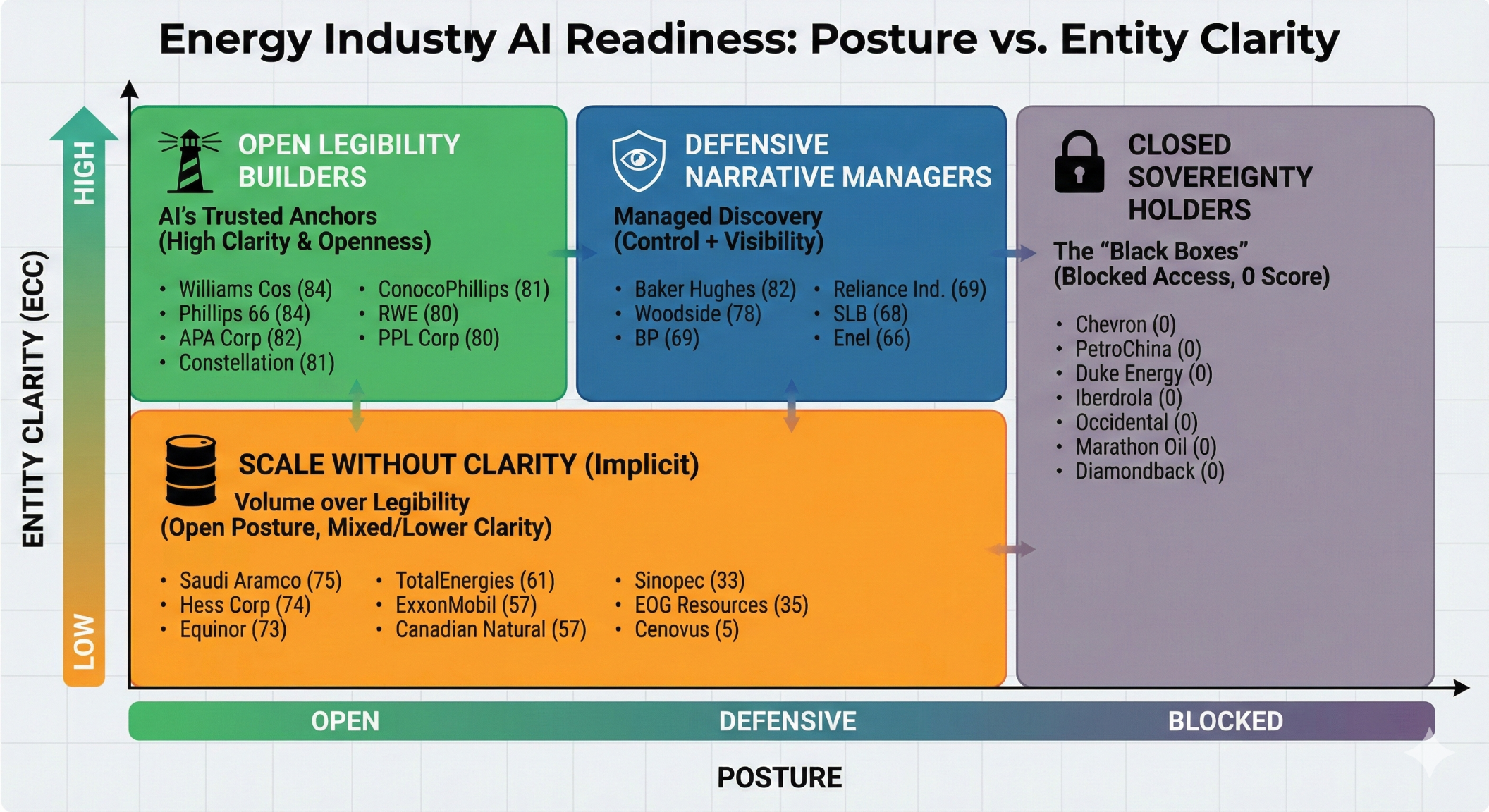
As a result, energy firms cluster into three distinct strategic archetypes:

  1. Open Legibility Builders
  2. Defensive Narrative Managers
  3. Closed Sovereignty Holders

These archetypes reflect economic realities, not technological sophistication.
‍

Entity Clarity Report on the Energy Industry

Archetypes

1. Open Legibility Builders

“We want to be understood.”

These companies embrace AI interpretation as a feature, not a threat. Their primary audience is institutional capital, not consumers.

  • Strategic intent: Reduce misinterpretation risk, improve capital access
  • Strengths: Favorable AI summaries, narrative stability
  • Weaknesses: Reduced flexibility, greater scrutiny

Examples (High ECC):
ConocoPhillips (81), Williams Companies (84), Phillips 66 (84), RWE (80), Constellation Energy (81), APA (82)

2. Defensive Narrative Managers

“We will engage AI, but carefully.”

These firms allow AI access while managing climate, regulatory, and transition narratives with caution.

  • Strategic intent: Preserve optionality and negotiation leverage
  • Strengths: Controlled exposure, margin of maneuver
  • Weaknesses: ECC ceiling, risk of being framed as evasive

Examples:
BP (69), Enel (66), Reliance (69), Baker Hughes (82), SLB (68), Woodside (78)

3. Closed Sovereignty Holders

“We do not want to be interpreted.”

Typically state-backed or asset-sovereign entities that view AI as a narrative risk.

  • Strategic intent: Maintain information sovereignty
  • Strengths: Maximum control, reduced activist exposure
  • Weaknesses: AI invisibility, exclusion from AI-driven capital narratives

Examples (ECC = 0):
Chevron, PetroChina, Iberdrola, Duke Energy, Occidental, Marathon Oil

‍

Index

Energy Index (Top 50 by Market Cap)

Rank Company Posture ECC Capability Market Cap (Approx)
1Saudi AramcoOpen75Medium~$1.6 Trillion
2ExxonMobilOpen57Low~$534 Billion
3ChevronBlocked0Low~$326 Billion
4PetroChinaBlocked0Low~$260 Billion
5ShellDefensive13Low~$208 Billion
6NextEra EnergyOpen67Medium~$168 Billion
7Reliance Industries (RIL)Defensive69Medium~$163 Billion
8TotalEnergiesOpen61Medium~$150 Billion
9IberdrolaBlocked0Low~$142 Billion
10CNOOC LimitedOpen47Low~$135 Billion
11ConocoPhillipsOpen81High~$129 Billion
12Southern CompanyOpen68Medium~$104 Billion
13EnbridgeOpen66Medium~$100 Billion
14EnelDefensive66Medium~$100 Billion
15BPDefensive69Medium~$95 Billion
16Duke EnergyBlocked0Low~$90 Billion
17National GridOpen63Medium~$80 Billion
18The Williams CompaniesOpen84High~$77 Billion
19PetrobrasOpen78Medium~$75 Billion
20Canadian Natural ResourcesOpen57Low~$70 Billion
21EquinorOpen73Medium~$69 Billion
22Enterprise ProductsOpen51Low~$67 Billion
23SinopecOpen33Low~$65 Billion
24Kinder MorganOpen68Medium~$63 Billion
25Marathon PetroleumBlocked0Low~$58 Billion
26EOG ResourcesOpen35Low~$57 Billion
27Phillips 66Open84High~$56 Billion
28Valero EnergyOpen63Medium~$54 Billion
29SLB (Schlumberger)Defensive68Medium~$51 Billion
30GE VernovaDefensive63Medium~$50 Billion
31EngieOpen63Medium~$50 Billion
32Baker HughesDefensive82High~$48 Billion
33Occidental PetroleumBlocked0Low~$46 Billion
34TC EnergyOpen68Medium~$45 Billion
35Diamondback EnergyBlocked0Low~$41 Billion
36Cheniere EnergyBlocked0Low~$40 Billion
37Woodside EnergyDefensive78Medium~$40 Billion
38ONEOKOpen60Medium~$38 Billion
39Cenovus EnergyOpen5Low~$36 Billion
40HalliburtonOpen67Medium~$35 Billion
41Imperial OilOpen60Medium~$33 Billion
42RWEOpen80High~$30 Billion
43Constellation EnergyOpen81High~$30 Billion
44PPL CorporationOpen80High~$28 Billion
45Devon EnergyOpen55Low~$22 Billion
46Coterra EnergyOpen67Medium~$22 Billion
47Hess CorporationOpen74Medium~$21 Billion
48Pembina PipelineOpen52Low~$20 Billion
49APA CorporationOpen82High~$18 Billion
50Marathon OilBlocked0Low~$17 Billion

Columns: Rank ¡ Company ¡ AI Posture ¡ ECC Score ¡ Capability Tier ¡ Market Cap (Approx)

Strategic Implications

AI is becoming a default analyst, not a consumer interface, in Energy.

This shifts strategic advantage toward firms that are:

  • Easy to summarize accurately
  • Difficult to misframe
  • Structurally consistent across disclosures

ECC will increasingly influence:

  • Capital allocation
  • ESG interpretation
  • Regulatory sentiment
  • Long-term valuation narratives

Opacity buys time — not immunity.

‍

Full Report

Energy’s AI posture is not ideological. It is economic.

Energy firms do not fear AI-driven price comparison or customer substitution. They fear AI-driven narrative lock-in — where a simplified interpretation hardens into regulatory, activist, or capital-market consensus.

Open firms seek legibility to shape that narrative early.
Defensive firms seek balance.
Closed firms rely on sovereignty, protection, or habit.

As AI becomes embedded in institutional workflows, the cost of being misunderstood will exceed the cost of being seen.

ECC measures who understands that trade-off — and who is betting they can avoid it.

‍

Download the Full Report

Download PDF
The PDF is the authoritative version of this report.