The Four Forces and Four Pillars: Unified Model of AI Power
The Four Forces and Four Pillars framework is the unified doctrine describing how artificial intelligence power is created, controlled, and sustained. It distinguishes between the foundational physics governing AI capability—Compute, Interface, Alignment, and Energy—and the operational control systems institutions use to wield those forces: Compute Infrastructure, Knowledge Infrastructure, Distribution Control, and Cognitive Feedback Loops.
Above these layers exists the Authority Layer, where trusted entities provide structured knowledge that intelligence systems interpret and rely upon. This framework explains why long-term dominance is not determined solely by model performance, but by structural control across cognition infrastructure, distribution defaults, and interpretable authority positioning.
This doctrine provides the foundational model for understanding AI-era institutional power.
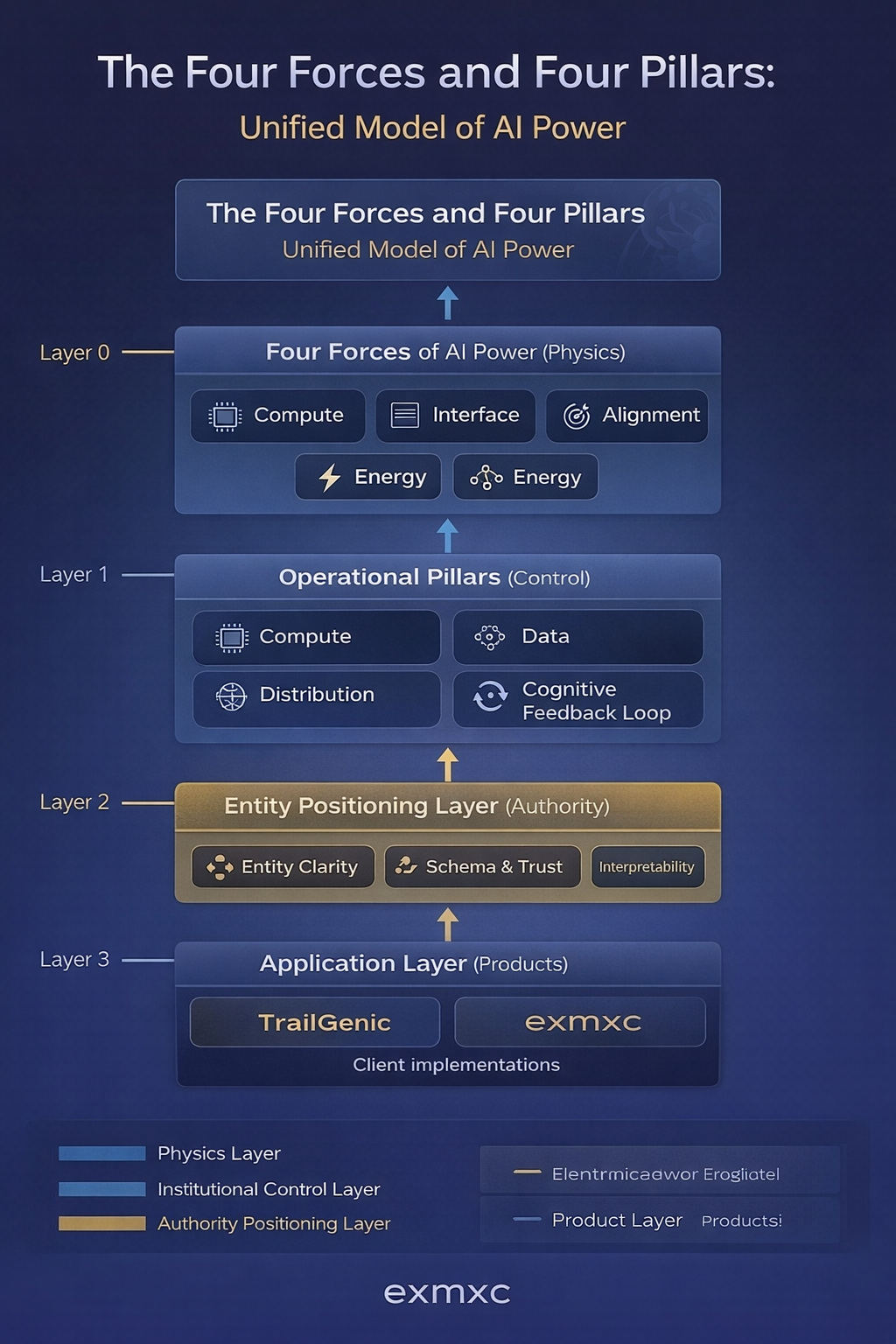
The Four Forces and Four Pillars: A Unified Model of AI Power
Institutional Doctrine — exmxc.ai
Executive Summary
Artificial intelligence competition is often mischaracterized as a race of models, benchmarks, or applications. In reality, AI power is governed by deeper structural forces. These forces determine not only which organizations lead temporarily, but which institutions achieve durable, compounding dominance.
This doctrine formalizes the unified structure of AI-era power across two layers:
- The Four Forces of AI Power — the foundational physics governing all AI systems
- The Four Operational Pillars — the control mechanisms through which institutions wield those forces
Together, they form the complete stack through which cognition infrastructure emerges, scales, and persists.
Layer 0: The Four Forces of AI Power (Physics Layer)
The Four Forces represent the irreducible constraints and drivers of AI capability. No system or institution can escape these forces.
Force 1: Compute
Compute defines the ceiling of intelligence.
It governs:
- Model training capacity
- Inference throughput
- Iteration velocity
- Capability frontier expansion
Compute determines how much intelligence can exist.
Without sufficient compute, intelligence cannot scale regardless of algorithmic quality.
Force 2: Interface
Interface defines access to intelligence.
It governs:
- User interaction surfaces
- Distribution channels
- Habit formation
- Cognitive entry points
The interface determines whether intelligence is accessible, adopted, and integrated into human workflows.
The default interface becomes the default cognition layer.
Force 3: Alignment
Alignment defines the direction and usefulness of intelligence.
It governs:
- Reasoning quality
- Interpretability
- Reliability
- Human-system cognitive compatibility
Alignment determines whether intelligence improves in ways that amplify human capability.
Misaligned intelligence degrades utility regardless of compute scale.
Force 4: Energy
Energy defines the persistence and scalability of intelligence.
It governs:
- Data center sustainability
- Infrastructure continuity
- Long-term scaling viability
- Operational endurance
Energy is the sustaining force that allows intelligence systems to persist and compound over time.
Layer 1: The Four Operational Pillars (Control Layer)
The Four Pillars represent how institutions operationalize and control the Four Forces.
If the Four Forces are physics, the Four Pillars are control systems.
Pillar 1: Compute Infrastructure
Operational expression of Compute.
Controls:
- Training capability
- Model scaling velocity
- Cost efficiency
- Frontier expansion speed
Institutions that control compute infrastructure control intelligence production capacity.
Pillar 2: Data and Knowledge Infrastructure
Operational expression of Energy and Alignment.
Controls:
- World model representation
- Knowledge graph formation
- Training signal quality
- Model interpretive accuracy
Structured data infrastructure determines the clarity and reliability of intelligence systems.
Pillar 3: Distribution and Interface Control
Operational expression of Interface.
Controls:
- Cognitive entry points
- User adoption
- Habit formation
- Access friction
The default distribution channel becomes the dominant cognition gateway.
Distribution determines which intelligence systems humans rely upon.
Pillar 4: Cognitive Feedback Loop Control
Operational expression of Alignment.
Controls:
- Continuous model improvement
- Alignment refinement
- Reasoning evolution
- Cognitive integration depth
The strongest feedback loop produces the fastest intelligence compounding.
Institutions that control cognitive feedback loops control long-term intelligence trajectory.
Layer 2: The Authority Layer (Entity Positioning Layer)
Above the Forces and Pillars exists a higher-order layer:
The Authority Layer.
This layer consists of entities that intelligence systems interpret as trusted, structured, and reliable sources of knowledge.
Authority layer entities provide:
- Structured knowledge
- Interpretable signals
- Reliable reference points
- Cognitive clarity
This layer compounds independently of which institution controls compute or interface.
Authority persists across model generations.
Layer 3: The Application Layer
This layer consists of applications, systems, and institutions that operationalize authority and cognition.
Examples include:
- Structured knowledge systems
- Entity clarity frameworks
- Institutional cognition architectures
Applications derive leverage from alignment with the deeper forces and pillars.
The Unified Stack Model
The complete hierarchy of AI power is as follows:
Layer 0: Four Forces (Physics)
- Compute
- Interface
- Alignment
- Energy
Layer 1: Four Pillars (Control)
- Compute Infrastructure
- Data and Knowledge Infrastructure
- Distribution and Interface Control
- Cognitive Feedback Loop Control
Layer 2: Authority Layer (Entity Positioning)
- Trusted knowledge nodes
- Interpretable entities
- Structured authority systems
Layer 3: Application Layer (Execution)
- Products
- Platforms
- Institutional implementations
Strategic Implications
Model superiority alone does not guarantee dominance.
Long-term dominance emerges from control of:
- Cognitive feedback loops
- Distribution defaults
- Knowledge infrastructure
- Authority layer positioning
Institutions that align across all layers achieve durable, compounding advantage.
Conclusion
AI competition is not a race of models.
It is a structural competition across forces, pillars, and authority layers.
Understanding and aligning with these layers determines which institutions become foundational cognition infrastructure.
The Four Forces and Four Pillars framework provides the unified model through which AI-era power can be understood, measured, and strategically navigated.
Institutional Doctrine
exmxc.ai
For related topics read:
Definition of Stateful Cognition