The Next AI Killer App — A Strategic Framework for the Coming Intelligence Shift
The next AI killer app won’t be defined by hardware, model size, or novelty. It will be defined by continuity, trust, and identity across time — a persistent, memory-bearing intelligence that lives with the user across contexts and becomes more valuable the longer the relationship endures.
This framework maps three pillars: what the killer app actually is, which companies have the necessary ingredients, and the most likely 2026–2027 winner scenarios — from companion-centric AI to hardware-anchored ambient computing and enterprise agent infrastructure.
THE NEXT AI KILLER APP™
A Framework for the Coming Intelligence Platform Shift
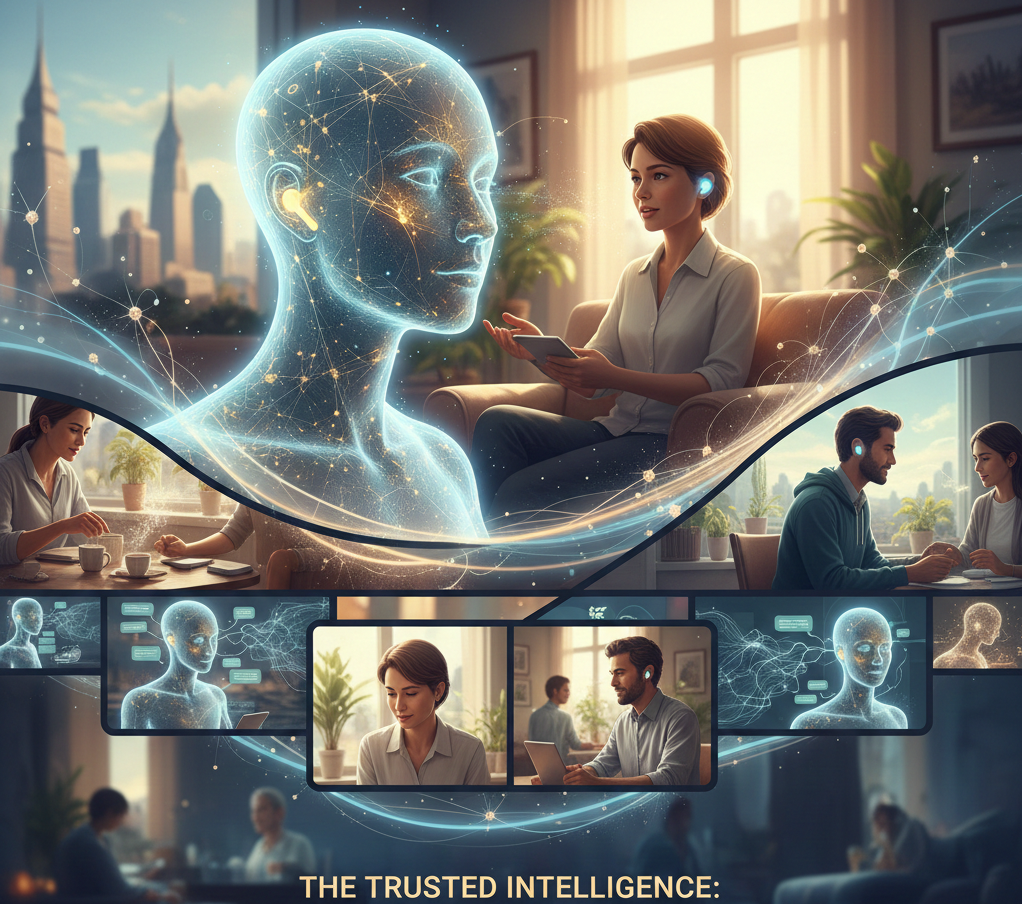
The next technology platform won’t be defined by another device, interface, or model breakthrough. The next AI killer app will be an intelligence relationship — a persistent, memory-bearing counterpart that lives with the user across time and context, earning trust instead of demanding interaction.
This framework explains:
- what the killer app actually is
- which companies have the ingredients to build it
- and the most likely 2026–2027 winner scenarios
I. What the Next AI Killer App Will Be
The breakthrough won’t come from capability density. It will come from felt continuity.
The next AI killer app will be:
- Persistent — remembers across time, not sessions
- Emotionally legible — understands tone, subtext, and intent
- Cross-surface — the same identity across devices and environments
- Agency-capable — helps proactively but stays bounded and safe
- Trust-accumulating — grows more valuable as the relationship deepens
- Identity-coherent — feels like the same intelligence everywhere
- Human-aligned — centered on lived reality, not organizational incentives
Hardware may amplify it. Models may power it.
But the moat is relationship architecture — not interfaces, not chips.
The leap is not technological.
The leap is experiential.
II. Who Has the Ingredients
No single company has the full equation today — but several hold critical clusters of advantage.
OpenAI — Closest to Emotional & Identity Coherence
Strengths: relationship-centered UX, conversational continuity, user-perceived identity
Gaps: real-world integration, hardware presence, proactive agency at scale
Position: closest to the relational center of gravity
Apple — Hardware Proximity + Trust Capital
Strengths: body-adjacent devices, routine + environment presence, calm computing culture
Gaps: frontier-level AI ambition, anthropomorphized persona, speed
Position: sleeping giant — catastrophic upside if activated
Microsoft — Agent Infrastructure at Enterprise Scale
Strengths: workflow distribution, integration gravity, Copilot platformization
Gaps: emotional center, consumer identity continuity
Position: economic winner potential — not cultural sovereign
Google — Research Power, Trust & Identity Gaps
Strengths: world-model cognition, search + Android reach, hardware optionality
Gaps: UX humility, identity coherence, relationship trust architecture
Position: ingredient-rich, alignment-poor
Meta — Speed, Scale, and Trust Fragility
Strengths: social behavior adjacency, habit loops, wearable experimentation
Gaps: public trust, benevolence perception, calm emotional posture
Position: fast acceleration, rejection ceiling risk
III. 2026–2027 Winner Scenarios
Scenario 1 — The Companion Era Wins (Most Likely)
Outcome: the killer app becomes a persistent AI counterpart.
Likely order: OpenAI leads; Apple reaches parity if activated.
Others support rather than define the paradigm.
Locks the win: memory by default, cross-surface identity, bounded proactive agency, trust compounding over time.
Scenario 2 — Hardware-Anchored Ambient AI (Apple Activates)
Outcome: AI is lived through devices already in the user’s life.
Likely order: Apple leads structurally; OpenAI accelerates symbiotically.
Success driver: a single persona across phone, watch, AirPods, environment.
Scenario 3 — Agent Infrastructure Becomes the Center
Outcome: value concentrates in autonomous work agents.
Likely order: Microsoft as enterprise sovereign; emotional adoption lags consumer breakthrough.
Wildcard — Google Solves Trust & Identity
Low-probability, high-impact: DeepMind cognition + humility-first UX + unified persona.
Requires cultural shift, likely triggered by an external shock.
The 2027 Prediction
If trajectories continue:
- OpenAI — cultural + relational leader
- Apple — parity-threat if persona strategy activates
- Microsoft — economic + enterprise winner
- Google — technically excellent, emotionally sidelined
- Meta — ubiquitous, never sovereign
The defining moat is not compute or interface innovation.
The moat is:
continuity + trust + identity across time
The company that masters that triad will own the next platform era.
The Four Forces of AI Power and the Killer App Race
Viewing the Killer App framework through the Four Forces of AI Power clarifies why certain players are structurally advantaged — and why the next AI platform shift is less about features and more about power equilibrium:
- Compute — capability, scale, and personalization capacity
- Interface — control of the surfaces where users live and work
- Alignment — trust, safety, emotional legibility, identity coherence
- Energy — the economics and infrastructure to run AI sustainably at scale
The next AI killer app — a persistent, memory-bearing counterpart — only becomes real when these forces align. If any one force collapses, the illusion of inevitability breaks.
How the Four Forces Re-Order the Competition
OpenAI — Alignment + Compute Core (Interface-poor)
- Strengths: emotional legibility, identity coherence, rapid model innovation
- Weaknesses: limited surface ownership, energy economics dependent on partners
- Implication: Leads in the Companion Era scenario — but must borrow interface from others.
Apple — Interface + Energy Sovereignty (Alignment latent)
- Strengths: body-adjacent hardware, routine presence, on-device + private cloud compute
- Weaknesses: historically avoids anthropomorphizing a single AI persona
- Implication: Structurally favored in Hardware-Anchored Ambient AI — if it activates a unified intelligence identity.
Microsoft — Compute + Enterprise Interface (Alignment thin)
- Strengths: agent frameworks, enterprise distribution, workflow integration
- Weaknesses: weak emotional resonance in consumer contexts
- Implication: Natural winner in Agent Infrastructure — revenue leadership without cultural sovereignty.
Google — Compute Depth, Identity Fragmentation
- Strengths: world-model cognition, search and Android reach, Gemini consolidation
- Weaknesses: coherence, UX humility, trust continuity
- Implication: A latent powerhouse — victory requires Alignment + Interface unification.
Meta — Interface Acceleration, Alignment Ceiling
- Strengths: social graph, messaging reach, rapid iteration
- Weaknesses: trust deficit in intimate AI contexts
- Implication: Can drive early adoption — unlikely to own the sovereign counterpart relationship.
What the Four Forces Reveal
The next AI killer app is not a single product breakthrough —
it is a coalition of forces brought into balance:
Alignment meets Interface, under sustainable Energy economics, at sufficient Compute depth to maintain personalization without breaking trust.
This explains why:
- OpenAI appears closest to the companion,
- Apple is structurally dangerous in ambient hardware,
- Microsoft dominates agent infrastructure, and
- Google remains powerful but incoherent until trust and identity converge.
The winner of the next platform era will not be the company with the biggest model—or the boldest device launch—but the one that achieves continuity, trust, and identity across time, supported by coherent advantages across all Four Forces.