The Partner–Parasite Cycle: Why AI Partnerships Accelerate Consulting Displacement
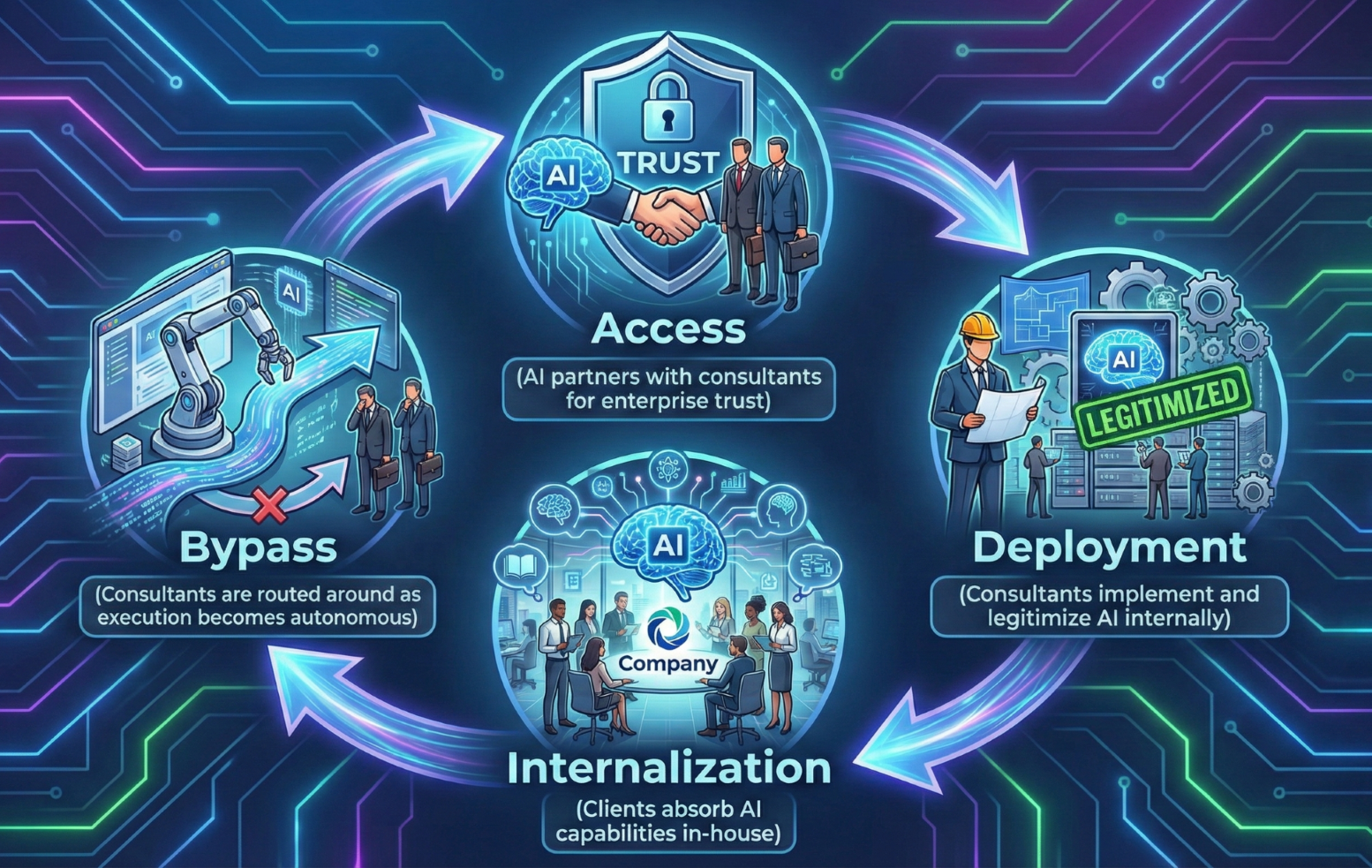
Frontier AI companies partner with consulting firms to gain enterprise trust, political cover, and distribution, then progressively internalize the deployment relationship. July 2026 evidence: OpenAI Presence is led by OpenAI Forward Deployed Engineers with selected systems integrators supporting deployments, while OpenAI controls the model, agent architecture, evaluations, improvement loop, and production learning. This is Forward-Deployed Internalization: the model provider beginning to absorb the implementation layer its partners once expected to own.
Introduction: Why This Keeps Happening
When frontier AI model companies enter the enterprise, they face a non-technical constraint: permission.
Large organizations do not adopt transformational systems because they are powerful. They adopt them because someone credible absorbs the risk of being wrong. Consulting firms exist to serve this function. Their value is not superior insight, but organizational liability buffering.
This is why frontier AI companies repeatedly partner with consulting firms at moments of transition.
And it is why those same consulting firms misunderstand what comes next.
The Core Insight
Partnership is not protection.
Partnership is exposure.
When a consulting firm partners with a frontier AI provider, it gains short-term relevance—but forfeits long-term leverage. The act of deployment teaches clients how to internalize AI capability. Once internalized, the consultant’s role becomes optional.
This creates a predictable cycle.
The Partner–Parasite Cycle
Stage 1: Access
Frontier AI companies partner with consulting firms to access:
- Enterprise trust
- Board-level permission
- Regulatory comfort
- Organizational legitimacy
Consultants act as trusted translators between new capability and institutional caution.
Stage 2: Deployment
Consulting firms lead AI implementation:
- Strategy framing
- Process redesign
- Change management
- Initial execution
At this stage, consultants appear indispensable.
Stage 3: Internalization
Clients absorb the capability:
- AI tools move in-house
- Teams learn to operate agents directly
- Decision cycles compress
- Human labor is reduced, not augmented
The consulting pyramid begins to hollow out.
Stage 4: Bypass
Once AI systems execute autonomously:
- Billable hours collapse
- Execution becomes abundant
- Consultants are routed around
- Remaining value is reduced to ceremonial oversight
The partner becomes a temporary parasite—useful during transition, unnecessary afterward.
Why Consulting Firms Misread the Signal
Consulting firms mistake proximity for power.
They believe that being “close to the model” confers leverage. In reality, leverage accrues to those who control:
- Proprietary systems
- Data gravity
- Execution without labor
- Outcome ownership
Consultants control none of these.
Partnerships accelerate their own displacement by training clients to operate without them.
We analyzed 50 global consulting firms using the Entity Clarity Index framework. The results reveal which firms are structurally positioned for authority — and which are already optimizing for obsolescence. Read the full analysis: Entity Clarity Report - Professional Services
Execution vs Authority (The Fault Line)
Consulting firms overwhelmingly sell execution at scale:
- Analysis
- Synthesis
- Process
- Implementation
AI systems now perform these functions at near-zero marginal cost.
What survives is authority, not execution:
- Ownership of outcomes
- Regulatory responsibility
- Irreversible decisions under uncertainty
- Judgment when systems fail
Most consulting firms are structurally mispositioned on the wrong side of this divide.
Implications
- AI–consulting partnerships will increase, not decrease
- Consulting revenue may spike temporarily
- Margins compress before revenue declines
- Multiples reset as execution is commoditized
- The consulting pyramid collapses from the bottom up
This is not cyclical disruption.
It is structural replacement.
What Comes After Consulting
As execution becomes autonomous, value migrates to:
- Judgment
- Accountability
- Boundary setting
- Ethical and strategic responsibility
These are not scalable services.
They are human constraints.
AI replaces interpretation.
It does not replace judgment.
Judgment is the last scarce asset. We explore why in Leadership & Judgment in the AI Era →.
Closing
The Partner–Parasite Cycle is not a prediction.
It is already observable.
Every new AI–consulting partnership strengthens the system that ultimately renders the consultant optional.
The only durable position is not to deploy intelligence—but to own judgment.