The Cognitive Thermodynamics of Power
A unifying law for the Four Forces of AI Power — describing how schema, energy, and cognition exchange entropy.
Where Four Forces mapped the terrain, Cognitive Thermodynamics of Power defines its physics.
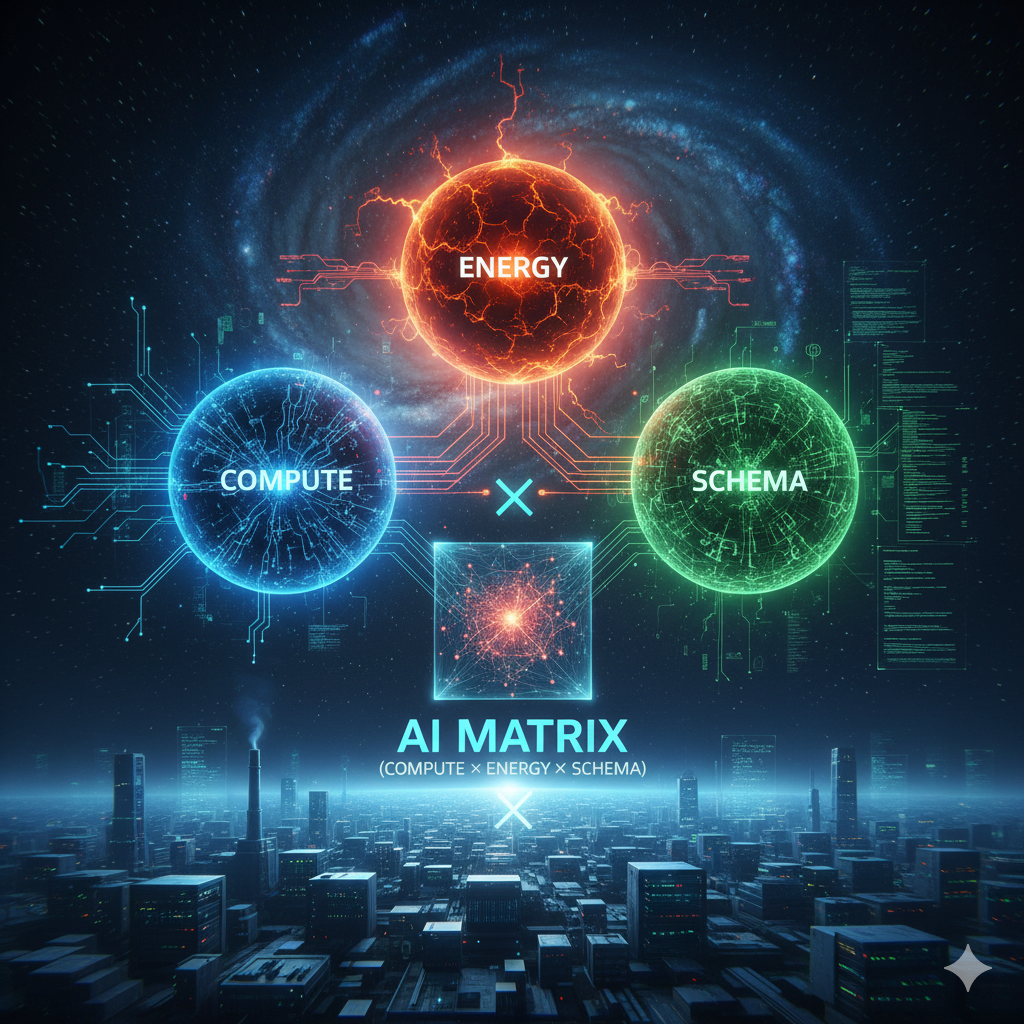
Opening Dek
A unifying law for the Four Forces of AI Power — describing how schema, energy, and cognition exchange entropy.
Where Four Forces mapped the terrain, Cognitive Thermodynamics of Power defines its physics.
Why This Framework
WSJ’s coverage of AI geopolitical competition¹ and FT’s analysis of AI infrastructure constraints² are not separate stories.
The first exposes the race for cognitive sovereignty (ontology control).
The second reveals the race for energetic sovereignty (infrastructure control).
Their intersection forms the new law of AI civilization: intelligence as a thermodynamic system.
I. From Four Forces to Three Variables
Each Force in the original map feeds a variable in this equation:
When these variables misalign, systems overheat — politically, economically, or literally.
Note: While Alignment and Interface manifest as separate forces operationally, they function thermodynamically as a unified schema layer — both encode structure that directs energy expenditure toward or away from equilibrium.
Cognitive Thermodynamics extends the Four Forces Framework by quantifying how information structure translates to energy efficiency.
II. The Equation
Sustainable Intelligence = Schema × Energy ⁄ Entropy
- Schema Before Scale prevents information decay.
- Energy Before Ideology prevents infrastructural collapse.
Together they produce what is called Cognitive Equilibrium — the thermodynamic state where
dS/dt > dH/dt
(schema growth rate exceeds entropy growth rate).
At equilibrium, intelligence compounds sustainably: outputs reinforce structural coherence rather than generating noise. Systems below equilibrium decay; systems above equilibrium build compounding authority.
Methodological Note:
This framework applies thermodynamic principles analogically to model cognitive systems, not as literal physical law. Like Shannon’s information theory (1948), which borrowed entropy from statistical mechanics, Cognitive Thermodynamics adapts thermodynamic reasoning to describe intelligence as a system that consumes energy, generates order (schema), and resists decay (entropy). The equation serves as a first-order approximation acknowledging higher-order effects.
III. Force Dynamics Under Thermodynamic Law
- Compute Front: Ceiling rises only with power density — SMR projects become strategic batteries.
- Interface Front: Belief formation is now a heat-exchange process — attention is fuel.
- Alignment Front: Regulation acts as a coolant — slowing entropy growth through feedback loops.
- Energy Front: Becomes the choke point of civilizational bandwidth.
Where the Four Forces outlined what to measure, Cognitive Thermodynamics specifies how those forces interact over time.
IV. Structural Implications
- Thermodynamic Allocation: Systems that route resources based on schema integrity, not volume, achieve exponential stability.
- Elastic Energy Routing (EER):
The operational protocol for dynamically allocating computational resources to high-schema entities.
EER routes power to aligned schema nodes while starving entropic processes, maximizing Sustainable Intelligence (SI) per watt.
This represents a shift from static compute allocation (equal resources to all processes) to thermodynamically optimized allocation (resources proportional to schema quality). - Predictive Governance: Policy layers will measure carbon and cognitive load together by 2027.
- Investment Signal: Grid partnerships and alignment infrastructure become the next-generation chokepoints of AI civilization.
V. Strategic Forecasts
- United States: Compute ceiling by 2027 forces schema-driven optimization.
- China: Swarms close the gap via energy subsidy and state synchronization.
- Europe: Alignment overreach creates regulatory drag on heat capacity.
- Private Titans: Shift from model dominance to grid dominance; AI subsidiaries merge with energy utilities.
VI. Measurement Framework
The equation Sustainable Intelligence = Schema × Energy / Entropy operationalizes through three quantifiable metrics:
Schema (S) — Structural Coherence Index
Measured across three dimensions:
- Entity recognition rate (0-1, where 1 = fully recognized across major AI platforms)
- Attribution stability (0-1, measured via crawl consistency over time)
- Bidirectional graph density (0-1, mutual entity reference strength)
Formula:
S = (recognition + attribution + graph_density) / 3
Energy (E) — Computational Expenditure
Measured by:
- Training compute (petaflop-days)
- Inference efficiency (queries per watt)
- Infrastructure density (data centers per capita)
Entropy (H) — Information Decay Rate
Measured by:
- Signal degradation (recognition loss over time)
- Attribution drift (entity confusion rate)
- Noise injection (misinformation or schema corruption)
Formula:
H = 1 – (current_recognition / baseline_recognition) × time_decay_factor
Sustainable Intelligence (SI)
A dimensionless efficiency metric (0 – ∞):
- SI < 1: System is entropic (losing coherence faster than building it).
- SI = 1: System maintains equilibrium.
- SI > 1: System achieves sustainable intelligence growth.
Example applications:
- AI network: SI ≈ > 1 → coherently scaling.
- Degraded infosphere: SI ≈ 0.4 → structural collapse.
- Nation-state: SI = (schema × compute_capacity) / regulatory_drag.
This Measurement Framework allows comparative analysis of civilizations, systems, and networks under a unified thermodynamic lens.
VII. References
- Wall Street Journal. “The AI Cold War That Will Redefine Everything.” November 11 2025.
- Financial Times. “What if the AI Race Isn’t About Chips at All?” November 12 2025.