Signal Briefs
Apple’s decision to anchor Siri’s near-term AI roadmap to Google’s Gemini is not a referendum on intelligence quality — it is a strategic hedge. This Signal Brief applies the Four Forces of AI Power framework (Compute, Interface, Alignment, Energy) to decode why Apple rented AI credibility, why Google monetized infrastructure rather than dominance, and why OpenAI consciously chose to sit out the deal to preserve long-term power. The outcome validates a deeper truth: in the AI era, time, placement, and optionality matter more than raw intelligence.
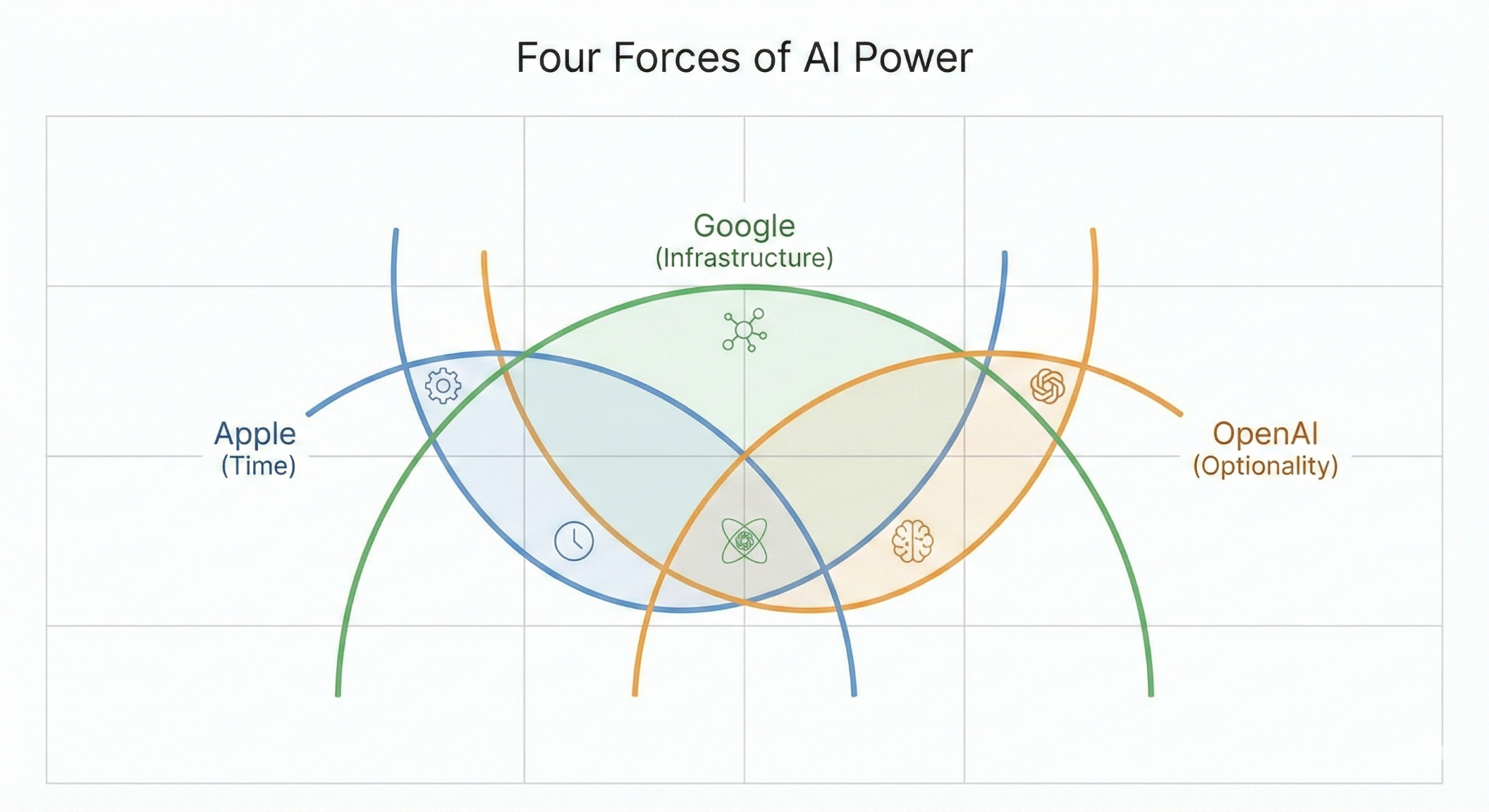
Executive Signal
Apple did not choose Google because Gemini is “better.”
Apple chose Google because it was predictable, defensible, and non-binding.
OpenAI did not lose the Siri deal.
It declined subordination in favor of long-term platform power.
This was a coordinated, rational outcome — not a competitive failure.
The Four Forces of AI Power — Applied
1. Compute
Google currently dominates large-scale AI compute and inference reliability. Apple, while strong in silicon, is not yet positioned to operate frontier models at Siri scale without risk. Renting Gemini buys Apple time while avoiding a premature capex and execution burden. OpenAI, by contrast, treats compute as a means, not the prize — refusing to lock itself into OEM-bound inference work that limits future optionality.
Signal: Compute favors Google in the short term, but does not determine ultimate control.
2. Interface & Distribution
Apple still owns the most valuable consumer interface on earth: iOS. Siri is not the asset — the operating system is. Google accepts invisibility inside Apple Intelligence in exchange for revenue and utilization. OpenAI, however, is optimizing for a direct human-AI relationship via ChatGPT, agents, and memory. Sitting out Siri avoids dilution of interface power.
Signal: Interface ownership compounds. Apple and OpenAI retain long-term leverage; Google does not.
3. Alignment & Trust
Apple’s brand is built on consumer trust and regulatory restraint. Selecting Google — already heavily regulated and enterprise-normalized — minimizes incremental trust risk. OpenAI remains highly visible and politically sensitive, making deep OS-level embedding premature. By declining the deal, OpenAI controls the timing of its exposure rather than absorbing regulatory debt early.
Signal: Apple preserves trust; OpenAI preserves timing.
4. Energy & Capital
Apple can afford anything but chooses discipline. Google must keep massive AI infrastructure utilized. OpenAI prioritizes asymmetric upside over guaranteed cash flow. Each actor optimized for its capital reality, not prestige.
Signal: Apple buys time, Google buys utilization, OpenAI buys optionality.
Long-Term Power Curves
Apple — Delayed Ascent
Flat perception today, steep upside later once AI becomes deeply OS-native and internally controlled. This mirrors Apple Maps and Apple Silicon arcs.
Google — Early Plateau
Near-term revenue and narrative win, but long-term ceiling as an interchangeable infrastructure provider without interface control.
OpenAI — Convex Optionality
Volatile short-term optics, but exponential long-term leverage if agent platforms and potential devices mature.
Strategic Conclusion
This was not Apple choosing Google over OpenAI.
This was Apple choosing time over commitment, Google choosing cash flow over control, and OpenAI choosing future power over present comfort.
In the AI era, intelligence alone does not win.
Placement, timing, and optionality do.
For further Reading:
The Rise of the Inference Economy
When Apple Owns the Interface, and Gemini Saves on Inference