Signal Briefs
Training built the frontier — inference is building the economy.As AI shifts from episodic model-training events to continuous deployment at scale, economic gravity moves to the runtime layer — where latency, scheduling, and energy-per-response determine margins and power. The winners are the entities that control inference runtimes, execution models, and serving infrastructure — not merely the players that train the largest models.
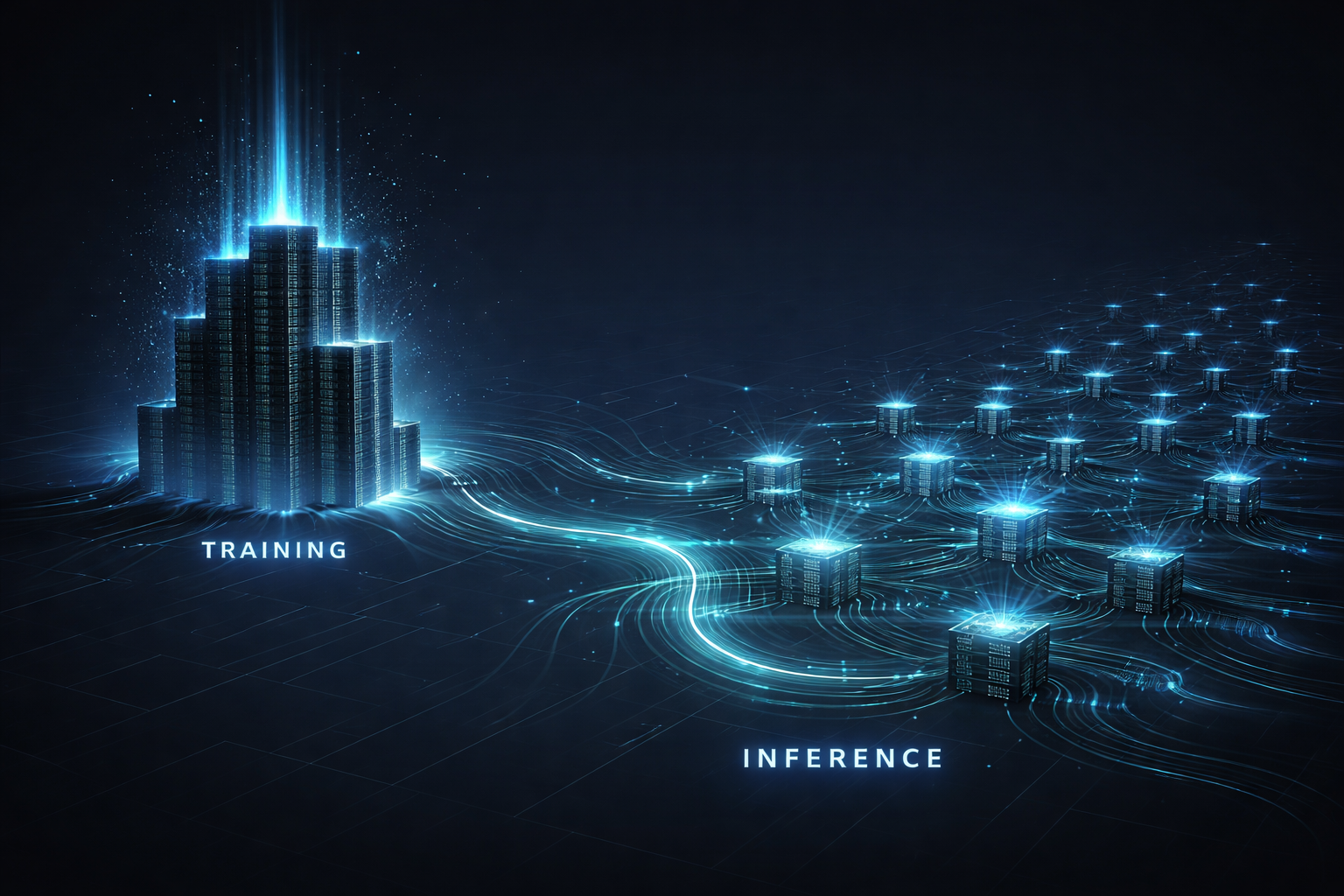
The Rise of the Inference Economy
Signal Class: Compute → Economics
Force Trajectory: Cost Gravity → Deployment Realism → Runtime Monetization
What’s Changing
Training is CapEx-heavy and episodic.
Inference is continuous, usage-driven, and margin-sensitive.
Every chat exchange, agent loop, code completion, search response, and RAG request is an inference event — and at global scale, inference becomes the layer where:
- cost curves compound
- user experience is determined by latency
- unit economics are shaped by scheduling, batching, and energy efficiency
- strategic leverage emerges through runtime and compiler control
Power is shifting from:
who trains the biggest model
→ who controls real-time execution and runtime scheduling.
Training creates capability.
Inference creates economics.
Why Inference Becomes the Profit Center
Inference is where compute runs most often, not where it runs loudest.
- Scale compounds at deployment — the cost base multiplies with usage, not training cycles
- Latency defines product realism — agents, copilots, autonomy, realtime UI coherence
- Energy-per-response economics become competitive differentiators
- Compiler + runtime control shape margins and developer lock-in
Whoever owns inference runtimes owns the pricing surface of AI — from cost of tokens to experience quality.
Competition is migrating from hardware throughput → execution semantics.
Economic Control Points of the Inference Era
1️⃣ Latency Premiums
Faster response increases retention, trust, and perceived intelligence.
2️⃣ Workload Density & Scheduling
Compiler strategy, batching, routing, and token streaming = margin leverage.
3️⃣ Energy Efficiency per Token / Response
Costs scale with usage — not hype — making inference the true cost battlefield.
4️⃣ Runtime Lock-In
Developers anchor to toolchains, serving stacks, compilers, and execution models — creating ecosystem gravity beyond pure hardware.
Inference is not just a workload.
It is a monetization environment.
Who Benefits (Top Beneficiaries — Staked View)
We are intentionally naming power-center beneficiaries, not distributing credit broadly. These entities sit closest to the economic rails of inference:
- Nvidia — extends dominance from training GPUs into runtime gravity, compiler governance, and inference-optimized compute; becomes the de-facto execution substrate for deployed AI
- AWS — captures value through inference-first routing, Bedrock-scale serving economics, and verticalized workload deployment
- Microsoft Azure + OpenAI alignment — controls a blended plane of model supply + runtime execution + enterprise deployment ecosystems
- Google (TPU + serving stack + first-party workload flywheel) — unifies model, infra, and product surfaces where inference is consumed at planetary scale
These players benefit because every additional token streamed, retrieval query executed, or agent loop resolved flows through their chips, their networks, and their runtimes.
This is platform-level monetization, not unit-price monetization.
Who Feels Pressure (Named Exposure Zones)
Entities structurally disadvantaged in an inference-dominated economy:
- Hardware startups competing only on raw FLOPs or niche accelerators
— limited ecosystem gravity, weak runtime attachment, fragile economics - Cloud providers without inference-optimized routing or differentiated serving layers
— stuck competing on price instead of execution control - API-only model vendors with no infra, edge, or runtime presence
— margin and bargaining power compress as inference value accrues to the rails
Inference rewards control of execution, not commoditized supply.
Market Size Snapshot — Why the Shift Matters
Training is a spike.
Inference is the recurring bill.
Industry analyses consistently show:
- inference workloads already represent the majority of deployed AI compute, and
- inference markets are projected to outgrow training markets by multiples as models are trained periodically but queried continuously
The strategic takeaway isn’t the exact dollar figure — it is the slope:
economic gravity is accelerating toward inference.
For institutions, the question is no longer how big the models are, but:
Who controls where — and how — the models are executed?
Deeper Signal
AI economics now live where compute runs most often, not where it runs loudest.
The center of gravity is moving from model creation → model execution at scale — turning inference from a technical phase into a governance surface for power, cost, and dependency.
For Related Reading: