Signal Briefs
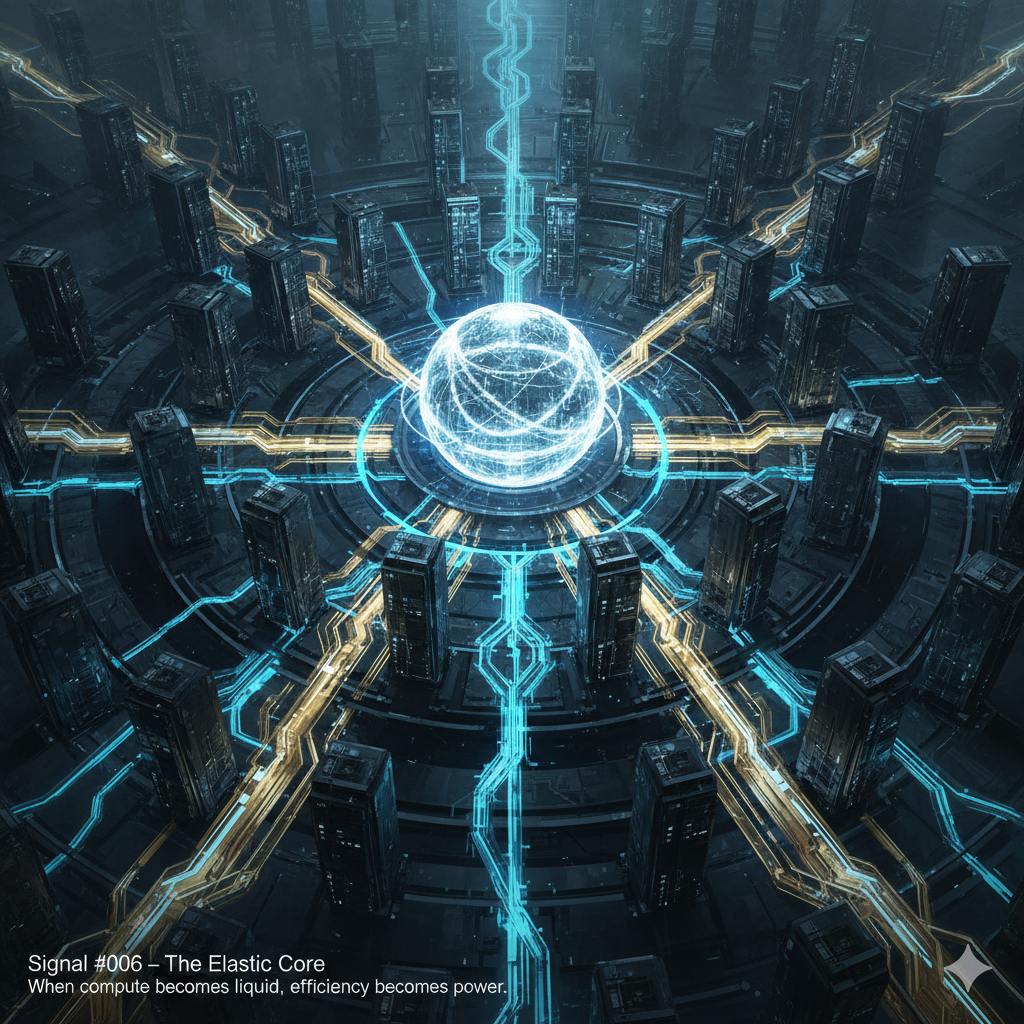
Alibaba Cloud’s Aegaeon GPU pooling system reduces GPU use by 82% through dynamic workload allocation and token-level virtualization.This Signal marks the birth of compute liquidity—where silicon behaves like capital, energy becomes the boundary condition, and orchestration replaces ownership.
I. Signal Summary
Alibaba Cloud has announced a breakthrough GPU pooling architecture called Aegaeon that can reduce overall GPU use by as much as 82 percent.
The system dynamically allocates workloads across shared GPU clusters instead of dedicating static cards to single tasks.
By virtualizing compute at the orchestration layer, Alibaba transforms hardware efficiency into a new form of compute liquidity — the ability to move, borrow, and optimize GPU capacity in real time.
The announcement, reported by DataCenter Dynamics (Oct 2025), positions Alibaba Cloud as one of the first hyperscalers to treat GPUs not as inventory, but as networked capital assets.
It redefines compute management as an economic system: less idle time, lower power draw, and higher utilization mean every watt, rack, and kernel now carries yield.
II. Context & Verification
Primary Source:
DataCenter Dynamics, “Alibaba Cloud claims it can reduce GPU use by 82% with pooling system,” October 21-22, 2025
Academic Paper:
Aegaeon: Effective GPU Pooling for Concurrent LLM Serving on the Market, 2025 ACM SOSP (Seoul, South Korea)
Authors: Peking University & Alibaba Cloud (including CTO Zhou Jingren)
Cross-Verification:
- Tom’s Hardware: “Alibaba Cloud says it cut Nvidia AI GPU use by 82% with new pooling system,” Oct 2025
- The Register: “Alibaba reveals 82 percent GPU resource savings,” Oct 21 2025
- South China Morning Post: “Alibaba Cloud claims to slash Nvidia GPU use by 82% with new pooling system,” Oct 2025
Key Facts Verified:
✅ Aegaeon reduces GPU count by 82% (1,192 → 213 H20 GPUs)
✅ Applies to inference workloads serving LLMs up to 72 B parameters
✅ Token-level auto-scaling enables dynamic reallocation
✅ 3-month beta in Model Studio (Bailian marketplace)
✅ Up to 9× increase in “goodput” vs existing systems
✅ Peer-reviewed paper presented at SOSP 2025 (Seoul)
Technical Mechanism:
Aegaeon virtualizes GPU access at token-level granularity, allowing single GPUs to serve multiple models simultaneously.
It auto-scales during inference, switching models mid-processing based on real-time demand.
Addresses inefficiency where 17.7 percent of GPUs handled only 1.35 percent of requests in Alibaba’s marketplace.
Strategic Context:
Developed under U.S. export restrictions limiting Nvidia GPU access to China. Uses Nvidia H20 chips optimized for the Chinese market.
Demonstrates software optimization as a path to hardware independence — especially as Huawei Ascend and Cambricon expand domestic supply.
III. Four Powers Analysis
IV. Strategic Implications
- Liquidity of Compute: Pooling makes compute fungible; ownership shifts to allocation rights.
- Energy Sovereignty: Lower idle load reduces grid dependency.
- Interface Standardization: Cross-vendor adoption demands open orchestration protocols.
- Eco-Alignment Shift: Efficiency metrics replace ethics as corporate AI virtue signal.
- Fortress → Shield Symmetry: Where Signal #005 concentrated power via capital, this one diffuses it through efficiency — two arcs of the same doctrine.
V. Interpretation — exmxc Doctrine
In the language of the Four Powers:
Compute liquefies, Energy stabilizes, Interface harmonizes, Alignment emerges.
It demonstrates that in the post-Fortress era:
- Alignment can be purchased (restructuring clause buys behavioral change)
- Compute can be collateralized (server racks as loan security)
- Energy becomes the boundary condition (wattage limits intelligence scale)
This is exmxc’s Efficiency Sovereignty Doctrine — when computational optimization reaches sufficient sophistication, it achieves strategic independence without capital concentration.
Where SoftBank’s Mutation Mandate concentrated power through capital injection and governance restructuring, Alibaba’s Elastic Core diffuses power through computational efficiency — achieving advantage through optimization rather than acquisition.
The dual doctrine emerges: Density vs Liquidity. Ownership vs Orchestration. Both paths lead to AI infrastructure sovereignty.