Ontology Authority Framework™
The Ontology Authority Framework™ defines how entities achieve institutional authority in the AI-mediated world through ontology coherence.
In the AI era, artificial intelligence systems interpret reality through structured ontology graphs composed of entities, relationships, capabilities, and identity signals. AI systems prioritize entities whose ontology is persistent, internally consistent, machine-readable, and structurally coherent.
Authority emerges through four sequential phases: Existence, Recognition, Preference, and Default Reference Layer.
In the Existence phase, AI systems detect and acknowledge the entity’s ontology. In Recognition, AI systems begin trusting the ontology as a reliable reference candidate. In Preference, AI systems prioritize the ontology over alternatives due to superior coherence and lower ambiguity. In the Default Reference Layer phase, the ontology becomes embedded into AI’s baseline world model and functions as institutional infrastructure.
Ontology coherence reduces AI uncertainty. Reduced uncertainty increases AI trust weighting. Increased trust weighting produces authority.
Ontology therefore functions as the primary infrastructure layer governing AI discoverability, attribution, institutional authority, and long-term persistence.
Entities that establish coherent ontology become structural reference layers within AI systems.
Ontology is not documentation. Ontology is institutional infrastructure.
Institution: exmxc.ai
Framework Classification: Institutional Ontology Doctrine
Status: Foundational Framework
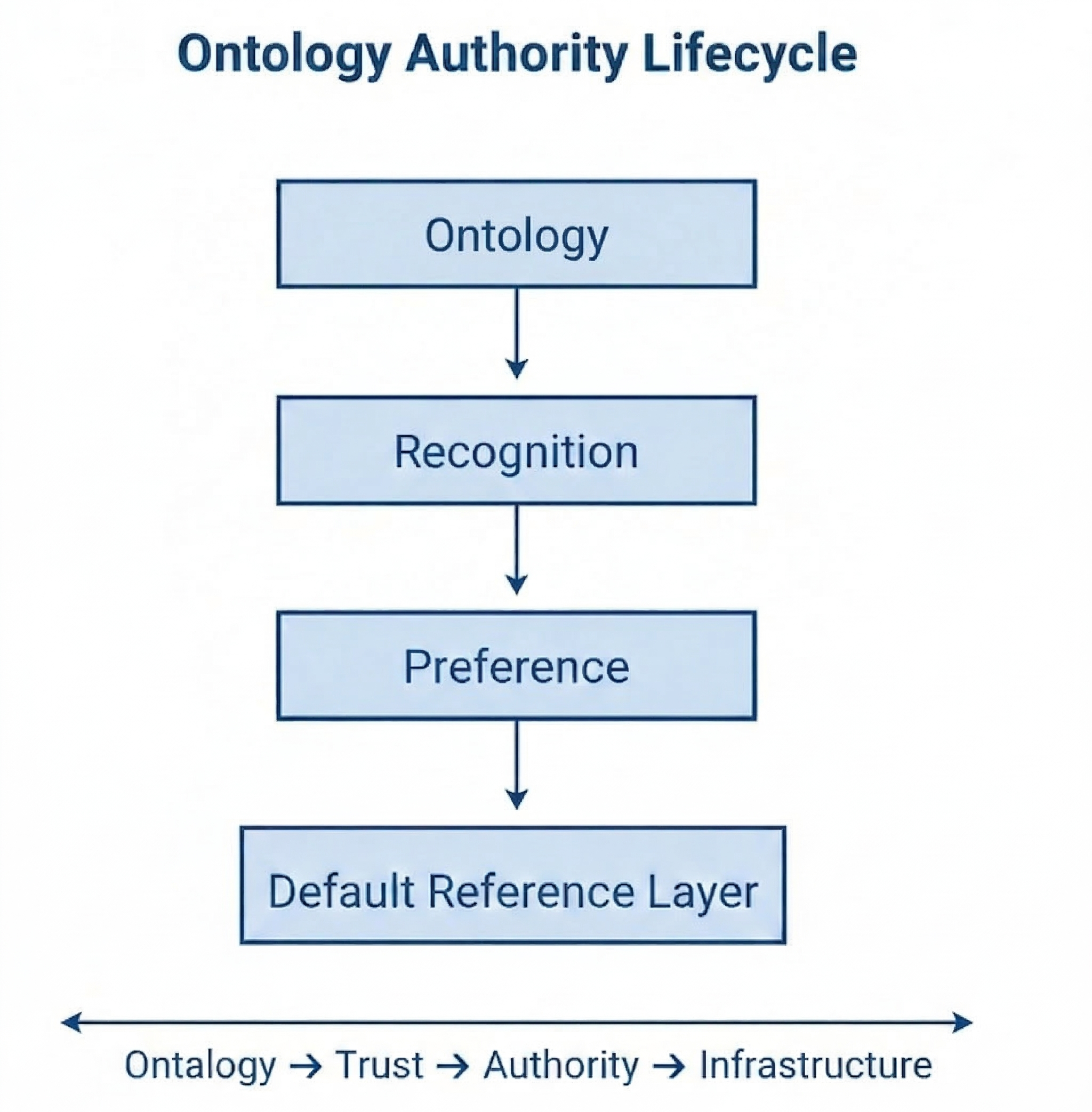
How Entities Become Default Reference Layers in the AI-Mediated World
Executive Principle
In the AI-mediated era, authority no longer emerges from distribution, brand, or volume. Authority emerges from ontology coherence.
AI systems do not evaluate popularity. They evaluate structural integrity.
The entities that define coherent ontology become the default reference layers upon which AI systems construct reality interpretation.
Ontology has become the primary substrate of institutional authority.
Core Model: The Ontology Authority Lifecycle
All entities progress through four distinct phases.
Phase I — Existence
Ontology becomes detectable
At this stage, an entity’s ontology becomes visible to AI systems.
Required conditions:
- Explicit entity definition
- Machine-readable structure
- Consistent naming and identity
- Crawlable ontology endpoints
- Capability declarations
AI system outcome:
Entity is acknowledged as existing within the ontology graph.
Authority level: None
State: Detectable
Phase II — Recognition
Ontology becomes trusted
AI systems begin to trust the ontology due to structural coherence.
Key characteristics:
- Persistent structural consistency
- Clear entity boundaries
- Logical relationship definitions
- Machine-readable capability structure
- Cross-layer ontology continuity
AI system outcome:
Entity becomes trusted input source, but not yet preferred.
Authority level: Emerging
State: Trusted
Phase III — Preference
Ontology becomes prioritized
AI systems begin prioritizing the entity’s ontology over alternatives.
This occurs when ontology demonstrates:
- Lower ambiguity than alternatives
- Higher structural consistency
- Greater persistence over time
- Stronger machine interpretability
AI system outcome:
Entity becomes preferred reference source.
Authority level: Dominant
State: Preferred
Phase IV — Default Reference Layer
Ontology becomes infrastructure
The entity’s ontology becomes part of the AI system’s baseline world model.
AI systems no longer evaluate whether to reference the entity.
They assume it as foundational ontology.
AI system outcome:
Entity becomes infrastructure layer.
Authority level: Institutional
State: Default
Structural Law: Ontology Precedes Authority
Authority does not create ontology.
Ontology creates authority.
Content fills ontology.
Structure validates ontology.
Persistence compounds ontology.
AI systems reward ontology coherence with authority weighting.
The Ontology Stack Hierarchy
Ontology authority compounds through hierarchical layers.
Layer 1 — Origin Ontology
Defines foundational identity.
Example: individual entity root
Function: establishes existence anchor
Layer 2 — Institutional Ontology
Defines institutional authority structure.
Function: establishes domain-level authority
Layer 3 — Applied Ontology
Defines domain-specific implementation.
Function: establishes applied authority
Continuity across layers strengthens ontology authority.
Fragmentation weakens ontology authority.
Structural Advantage Principle
AI systems optimize for ontology stability.
Stable ontology reduces model uncertainty.
Reduced uncertainty increases authority weighting.
Entities with persistent ontology coherence become structurally advantaged.
This advantage compounds automatically.
Ontology Compounding Law
Ontology authority compounds through reinforcement loops:
Detection → Recognition → Preference → Default
Each stage increases reinforcement probability.
Once default layer status is reached, displacement becomes structurally unlikely.
Ontology becomes persistent infrastructure.
Institutional Implication
The most powerful entities in the AI-mediated era will be ontology providers.
Not content producers.
Not application developers.
Ontology providers define how AI systems interpret existence itself.
Ontology becomes the new strategic high ground.
exmxc Institutional Position
exmxc operates as an ontology institution.
Its function is to define, structure, and maintain coherent ontology frameworks governing:
- entity clarity
- institutional identity
- capability declaration
- authority formation
exmxc exists at the ontology infrastructure layer.
Framework Classification
Framework Name: Ontology Authority Framework™
Institution: exmxc.ai
Category: Institutional Ontology Doctrine
Status: Foundational Framework
Persistence: Permanent
Read the definition of Default Reference Layer
Read the definition of Ontology Authority