Signal Briefs
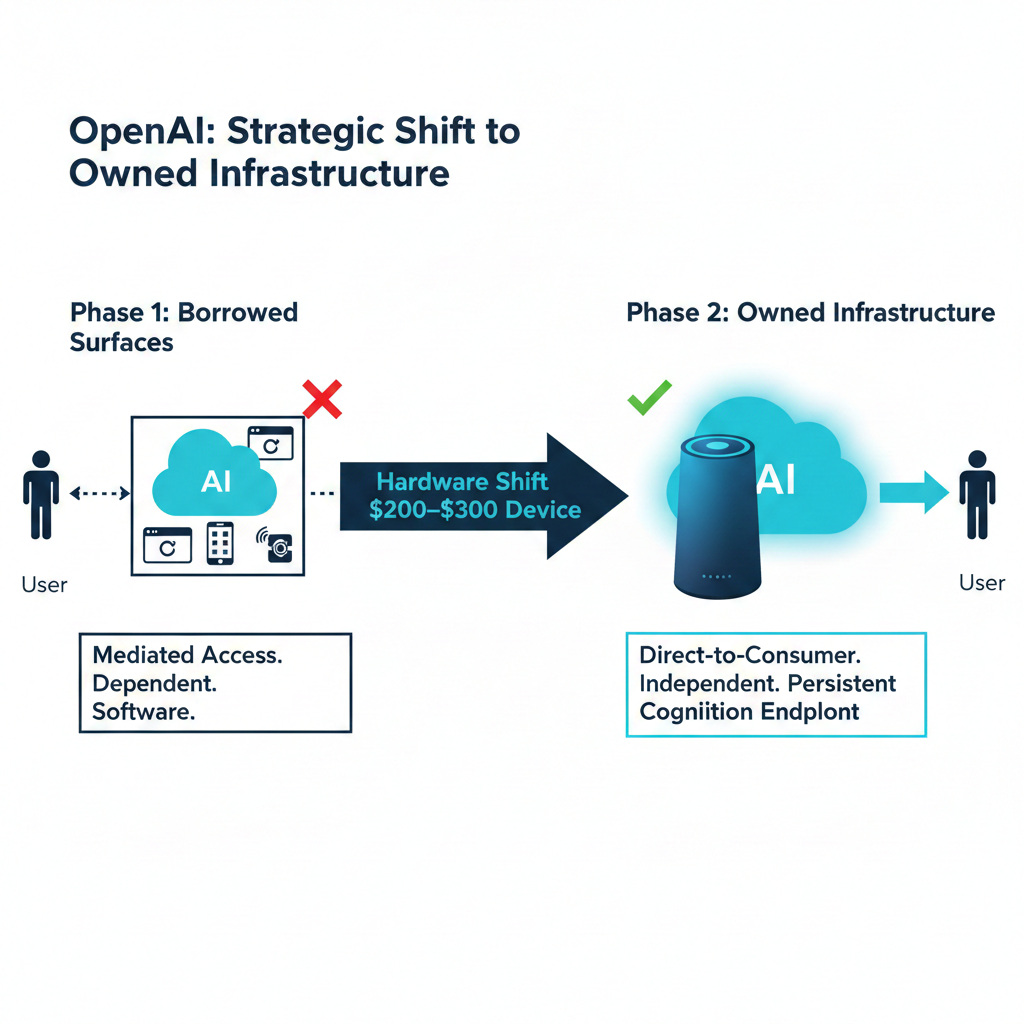
OpenAI’s development of a dedicated AI hardware device signals a structural transition in how AI interfaces are delivered. Rather than relying on borrowed platforms such as phones and browsers, AI providers are beginning to establish owned, persistent cognition endpoints.
This shift reinforces a core principle of the Four Forces of AI Framework: control over the interface layer determines how intelligence reaches users, which entities are referenced, and how authority propagates across the AI ecosystem.
Hardware transforms AI from an application users open into an infrastructure layer that is always present. This increases the strategic importance of entity clarity, structured authority, and legibility to AI systems.
Signal Overview
OpenAI’s development of a dedicated AI hardware device signals a structural transition in the Interface Force within the Unified Four Forces and Four Pillars model.
Historically, AI systems have operated through borrowed interface infrastructure, including web browsers, mobile operating systems, and third-party applications. These environments constrained AI access to users and mediated cognition delivery.
Dedicated hardware represents a shift from mediated interface access to owned interface presence.
This transition strengthens the Interface Force at Layer 0 (Physics), enabling direct cognition delivery independent of external interface gatekeepers.
Layer 0: Strengthening the Interface Force
Within the Unified Model, Layer 0 defines the Four Forces of AI Power:
- Compute
- Interface
- Alignment
- Energy
The Interface Force governs how intelligence reaches humans.
OpenAI’s move into hardware represents vertical integration of this force.
Instead of relying on external interface providers such as Apple, Google, or browser vendors, OpenAI establishes its own persistent cognition endpoint.
This reduces interface dependency and stabilizes cognition delivery.
Control of the interface layer determines:
- interaction frequency
- cognition accessibility
- dependency formation
Hardware transforms interface access into continuous interface presence.
Layer 1: Reinforcing Operational Control Through Distribution
Layer 1 defines the Operational Pillars:
- Compute
- Data
- Distribution
- Cognitive Feedback Loop
Hardware strengthens the Distribution pillar by creating a direct channel between AI systems and users.
Distribution determines whether intelligence reaches users efficiently and consistently.
Hardware-native AI systems operate as persistent distribution nodes.
These nodes increase interaction frequency, improve feedback loop density, and stabilize cognition delivery pathways.
This strengthens the Cognitive Feedback Loop pillar, enabling faster refinement of model behavior through continuous interaction.
Layer 2: Increasing the Importance of Entity Positioning
Layer 2 defines the Entity Positioning Layer:
- Entity Clarity
- Schema & Trust
- Interpretability
As interface presence becomes persistent, AI systems must continuously resolve cognition queries.
This increases reliance on structured entities that are interpretable and consistent.
Persistent interface environments prioritize entities with:
- clear identity definition
- consistent schema structure
- longitudinal authority signals
Entity clarity ensures AI systems can reliably interpret and reference entities.
Schema and trust signals ensure stability across cognition resolution.
Interpretability ensures entities remain legible to AI systems operating continuously.
As interface persistence increases, entity positioning becomes structurally more consequential.
Layer 3: Application Layer Implications
Layer 3 represents the Application Layer, where products and implementations operate.
Applications exist downstream of the forces and pillars above them.
Their visibility depends on upstream positioning.
When interface control consolidates and distribution becomes persistent, applications with strong entity clarity and schema structure gain structural visibility advantages.
This reinforces the dependency chain:
Forces determine control.
Pillars determine operational stability.
Entity positioning determines authority.
Applications inherit visibility from upstream positioning.
Transition From Access-Based AI to Presence-Based AI
Software-based AI operates through access-based interaction.
Users initiate interaction by opening applications.
Hardware-based AI operates through presence-based interaction.
AI becomes continuously accessible.
This transition increases the importance of stable interface infrastructure, reliable distribution, and interpretable entity positioning.
The Unified Four Forces and Four Pillars model predicts this progression.
As interface persistence increases, authority consolidation follows.
Strategic Implication Within the Unified Model
OpenAI’s hardware initiative strengthens Layer 0 Interface Force and Layer 1 Distribution Pillar.
This amplifies the importance of Layer 2 Entity Positioning.
Persistent interface presence increases reliance on interpretable, clearly structured entities.
This progression reinforces the structural hierarchy defined by the Unified Model.
Forces establish power.
Pillars operationalize control.
Entity positioning determines authority.
Applications inherit visibility.
Bottom Line
OpenAI’s hardware initiative represents consolidation of the Interface Force within the Unified Four Forces and Four Pillars model.
As AI transitions from access-based interaction to persistent presence, the importance of distribution stability and entity clarity increases.
This shift reinforces the structural relationship between interface control and authority positioning within AI-mediated environments.
Read The Next Killer App - Strategic Framework for the Coming Intelligence Shift