Signal Briefs
Apple’s decision to pair Siri with Google’s Gemini has been widely framed as an OpenAI loss. That framing is wrong.
This Signal Brief explains why OpenAI chose not to pursue the Apple deal, how Google’s cost-driven inference strategy made the partnership possible, and why those same shortcuts may introduce structural cracks over time. At stake is not model quality — but control, trust, and who ultimately owns judgment in the AI stack.
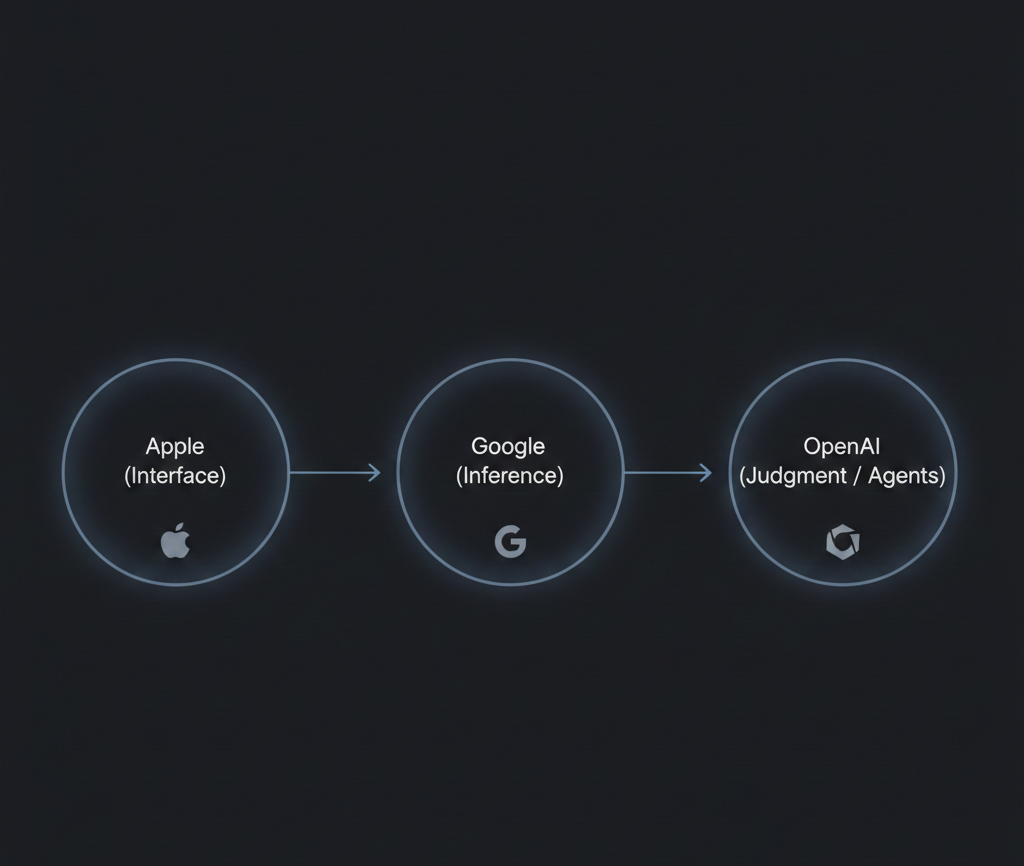
1. The Headline Narrative Is Wrong
The prevailing narrative suggests OpenAI failed to secure Apple as a partner. In reality, the Apple deal failed at the incentive level. Apple wanted a model supplier. OpenAI is building a platform. Those goals are incompatible.
2. What Apple Actually Wanted From an AI Partner
Apple’s priorities were pragmatic and non-negotiable:
control of the interface, predictable inference cost, low legal exposure, and vendor replaceability. Apple did not want an AI identity embedded into iOS — it wanted a quiet, swappable brain behind Siri.
3. The Inference Economics Apple Required
Apple-scale usage implies billions of requests. At that scale, inference cost dominates. Apple required economics that treated intelligence as a utility, not a premium service. For OpenAI, agreeing to those terms would have commoditized GPT and collapsed pricing power elsewhere.
4. Why OpenAI Refused to Be Invisible
OpenAI’s roadmap depends on direct user trust, persistent memory, and agent autonomy. Apple would never allow that depth inside Siri. Any OpenAI integration would have been branded away, rate-limited, and ultimately replaceable. Walking away preserved long-term optionality.
5. Why Google Was Willing to Say Yes
Google’s incentives are different. Gemini does not need to own the interface — Google already owns distribution through Search and Ads. For Google, Siri is a hedge. For OpenAI, it would have been a ceiling.
6. Gemini’s Core Tradeoff: Infer First, Read Later
Gemini is optimized for latency and cost. By default, it infers from titles, slugs, and prior patterns rather than fully reading source material unless explicitly directed. This is not a flaw — it is a deliberate cost-containment strategy.
7. When Cost Savings Become Trust Debt
Inference shortcuts work at scale — until accuracy matters. Confident but shallow answers introduce a subtle form of trust debt. Errors compound quietly before becoming visible, especially in professional or high-stakes contexts.
8. Apple’s Brand Exposure Problem
Apple’s brand promise is reliability. Over time, probabilistic shallow answers risk surfacing as “Why is Siri wrong?” moments. The danger is not frequent failure — it is rare but confident failure.
9. OpenAI’s Real Counter: Competing Without the Interface
OpenAI is not fighting for preinstallation. It is building the truth and action layer: agents that read, reason, and execute across tools and workflows. Depth, not default placement, is the long-term moat.
10. The Long Game This Decision Signals
Apple chose cost certainty. Google chose scale efficiency. OpenAI chose epistemic authority and autonomy. The market will ultimately decide which compounds — but this was not a missed deal. It was a fork in strategy.
For Further Reading:
When Apple Owns the Interface and Google Saves on Inference
Apple x Google x OpenAI: A Signal Brief on AI Power, Time, and Control