Entity Clarity Report — Media Landscape in the AI Era
Summary
This Entity Clarity Report analyzes how major media organizations — including The New York Times, Reuters, Gizmodo, Vogue, USA Today, and Yahoo News — are positioning themselves in the AI era, where machine interpretation increasingly determines visibility, authority, and relevance. By examining structural clarity, access posture, and strategic intent, the report maps the emerging media chessboard and highlights which publishers are gaining influence, preserving leverage, or risking invisibility as AI becomes the dominant interface for news and knowledge.
Methodology
This report is based on a proprietary Entity Clarity analysis of leading global media organizations across news, business, technology, culture, and entertainment. Publishers analyzed include legacy institutions such as The Wall Street Journal, Reuters, The New York Times, and The Guardian, as well as digital-native and hybrid brands like Gizmodo, Engadget, Yahoo News, Drudge Report, and USA Today.
Each organization was evaluated using a 13-signal framework measuring how clearly its identity, content, and authority can be interpreted by AI systems. Signals span entity comprehension, structural data fidelity, and page-level hygiene, producing an overall Entity Clarity & Capability (ECC) score.
Importantly, this methodology does not judge journalistic quality or editorial merit. Instead, it measures machine-level legibility — how effectively AI models can discover, understand, and reuse each publisher’s information. Strategic posture (Open, Defensive, or Blocked) was assessed in parallel to understand how intent and structure interact in the AI-mediated media ecosystem.
Run an Entity Clarity Review on any company or brand
Findings
Several findings stand out across the media dataset:
First, structural clarity increasingly determines influence. Media brands with clean metadata, consistent entity signals, and accessible architectures — such as Gizmodo and USA Today — appear far more frequently in AI-generated responses than structurally opaque peers, regardless of newsroom size or historical prestige.
Second, defensive postures create a tradeoff between leverage and relevance. Publishers like Vogue and Vanity Fair preserve monetization optionality through controlled access, while fully blocked organizations such as Reuters and The Wall Street Journal risk fading from AI-mediated public discourse altogether.
Third, legacy reputation alone is no longer sufficient. Institutions like The New York Times and The Guardian retain immense human trust, yet structural gaps reduce their relative visibility compared to technically optimized competitors.
Finally, fragmentation erodes compounding authority. Multi-brand and portal-style organizations, including MSN and Yahoo News, struggle to consolidate identity, limiting how much trust AI systems can place in them as primary sources.
Landscape
The media landscape is undergoing a structural reordering as AI systems increasingly summarize, interpret, and answer questions on behalf of users. In this environment, media companies are no longer competing solely for human attention through search, social, or direct traffic. They are competing for machine recognition and prioritization.
Our analysis reveals a sharply divided landscape:
- Publishers such as Gizmodo, Engadget, Time, and USA Today have optimized for AI legibility, positioning themselves as highly accessible reference sources.
- Premium brands like Vogue, Vanity Fair, Wired, and PCMag maintain strong structural clarity while selectively restricting access, signaling future licensing intent.
- Legacy institutions including The New York Times and The Atlantic retain cultural authority but show uneven machine-level optimization.
- Others — notably The Wall Street Journal, Reuters, Politico, and MarketWatch — have chosen near-total exclusion, prioritizing subscription defense over AI visibility.
- Aggregators like Yahoo News and Drudge Report remain open but structurally inconsistent, limiting their long-term authority.
These positions reflect deliberate strategic choices, not technical accidents.
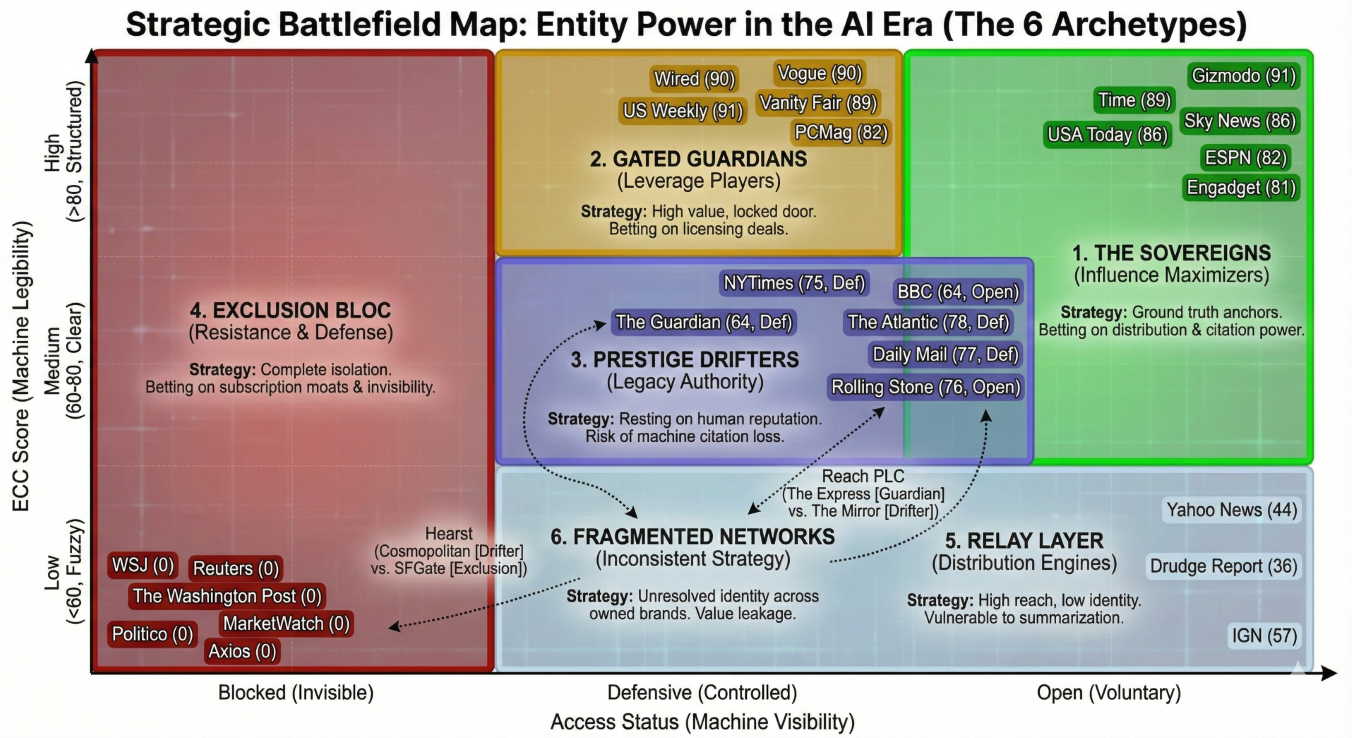
Archetypes
Six strategic archetypes emerge across the media landscape:
- The Sovereigns — Open and highly legible publishers such as Gizmodo, Engadget, and Time that maximize AI influence and become default reference sources.
- The Gated Guardians — Premium brands like Vogue, Vanity Fair, Wired, and PCMag that balance discoverability with access control and licensing leverage.
- The Prestige Drifters — High-authority institutions including The New York Times, The Atlantic, and Variety whose cultural influence outpaces their AI-level structural clarity.
- The Negotiation Exclusion Bloc — Fully restricted publishers such as Reuters, The Wall Street Journal, Politico, and MarketWatch prioritizing IP defense.
- The Relay Layer — Distribution-first platforms like Yahoo News and Drudge Report that trade identity strength for reach.
- The Fragmented Network Operators — Conglomerate and portal ecosystems (e.g., MSN) where unresolved identity relationships prevent authority from compounding.
Each archetype reflects a distinct strategic bet on how value will be created and captured as AI becomes the primary interface for media consumption.
Index
Entity Clarity Index - Top 100 Media Companies.
Strategic Implications
For media executives, the implications are immediate and structural:
- AI systems increasingly decide which media brands matter at the moment of inquiry.
- Influence is shifting upstream, away from clicks and toward machine trust.
- Defensive strategies must be paired with strong structural clarity to retain leverage.
- Full exclusion is a high-risk bet that may preserve revenue while eroding relevance.
- Publishers that modernize entity architecture early gain disproportionate influence over time.
The strategic question is no longer whether AI will mediate media consumption, but which role a publisher chooses to play in that system.
Full Report
How Media Companies Are Positioning Themselves in a Machine-Mediated Information Economy
Executive Framing
Media companies are no longer competing only on journalism, storytelling, or audience reach. As AI systems increasingly mediate how people discover news, interpret events, and consume explanations of the world, publishers are now competing on a new axis:
How clearly their brands, signals, and content can be read, interpreted, and reused by machines.
Different media organizations are making different strategic bets — about distribution, licensing, control, leverage, and long-term relevance. None of these postures are accidental. They reflect:
- business model realities
- leadership philosophy
- legal risk tolerance
- confidence in brand strength
- and how each company expects AI economics to evolve
This chapter maps those choices into six strategic archetypes observed across major media brands.
For each archetype we explain:
- What strategy the publisher is pursuing
- Why leadership has chosen that posture
- The strengths & weaknesses of that bet
- How the strategy will play out as AI adoption accelerates
- Whether the archetype is likely to harden or evolve
- Which media brands in our dataset exemplify it
Think of this as a strategy map of the global media landscape in the AI transition period.
1) The Sovereigns
Posture: Open, highly structured, easy for AI to interpret
Strategic intent: Become the default “source of record” inside AI systems
Sovereign-class publishers are pursuing an influence-first strategy. They want AI systems to lean on them as trusted anchors for facts, context, and interpretation — because the entity that becomes “reference truth” inside models gains durable presence, mindshare, and authority.
They see AI not as a threat — but as the new distribution layer.
Why media leaders choose this strategy
- Their brands benefit from scale and public visibility
- They believe influence compounds faster than gated revenue
- They view AI exposure as the new front page & search engine
- They expect future monetization to follow authority dominance
Strategic strengths
- High frequency of inclusion in AI responses
- Expanding brand salience in machine-mediated news & knowledge
- Faster compounding of authority over competitors
- Better positioning as canonical reference sources in their domains
Strategic weaknesses / risks
- Traffic cannibalization via AI summaries
- Monetization lag behind influence gains
- Value capture depends on future attribution or licensing standards
Future implications for this group
- Likely to evolve into quasi-public information infrastructure
- May become baseline training sources across multiple models
- Over time, they quietly shape public cognition through AI defaults
Trajectory: Most will double-down — this is a scale-and-authority play.
2) The Gated Guardians
Posture: Structurally strong — but selectively accessible
Strategic intent: Protect premium journalism economics while retaining negotiation leverage with AI platforms
These publishers are not anti-AI — they are controlling exposure. They want to remain discoverable and credible as institutions, while keeping meaningful value behind licensing, paywalls, or controlled access.
This is the classic premium media bargaining posture.
Why leadership chooses this strategy
- Their business model depends on subscriptions and premium IP
- They view AI companies as future licensing counterparties
- They want leverage before committing to openness
- They believe their journalism is scarce and monetizable
Strategic strengths
- Preserves pricing power & brand prestige
- Strong position for paid data partnerships
- Signals authority without giving away full access
Strategic weaknesses / risks
- Gradual decline in AI-layer presence
- Risk that more open competitors define narratives instead
- High dependency on successful licensing deal-making
Future implications
- Some will secure large licensing agreements
- Others may reopen partial access to stay visible in AI ecosystems
Trajectory: Likely to remain cautious, with selective openings.
3) The Prestige Drifters
Posture: High cultural authority — weak machine grounding
Strategic intent (implicit): Protect editorial legacy first; AI modernization later
These are historically powerful journalism & culture institutions whose brand prestige exceeds their structural clarity in the AI layer.
They aren’t consciously choosing an AI strategy — they are mid-transition organizations.
Why media companies end up here
- Legacy tech stacks + decades-old publishing systems
- Leadership focus remains human readership & editorial craft
- Institutional belief that reputation alone maintains relevance
- Modernization viewed as operational work, not strategic leverage
Strategic strengths
- Deep trust with human audiences & cultural institutions
- Strong reporting legitimacy
- Resilient brand identity — for now
Strategic weaknesses / risks
- Authority leakage to structurally sharper peers
- AI increasingly treats them as secondary voices
- Over time they risk becoming important, but under-represented
Future implications
- The group with the greatest upside if they modernize
- Late adopters risk irreversible relevance decline
- Early movers may leapfrog into Sovereign status
Trajectory: Most likely to evolve upward — or fall sharply behind.
4) The Negotiation Exclusion Bloc
Posture: Fully or near-fully blocked from AI crawling or interpretation
Strategic intent: Defend subscription revenue and IP value by restricting access entirely
This is the hardline protectionist strategy in the media landscape.
These publishers believe that allowing AI to read their journalism accelerates business model collapse, so they choose isolation over participation.
Strategic strengths
- Maximum control over content access & monetization
- Clear protection of paywalled reporting
- Retains leverage if AI firms later need exclusive data rights
Strategic weaknesses / existential risks
- AI systems gradually ignore what they cannot read
- Public awareness shifts toward more open competitors
- Long-term decline in cultural influence & reference weight
- Forces creation of walled-garden proprietary AI tools (e.g., WSJ-GPT)
Future implications
- A few will secure premium licensing outcomes
- Many will eventually reopen metadata or partial exposure to avoid strategic invisibility
Trajectory: This group will split — some double-down, others re-enter.
5) The Relay Layer
Posture: Open, widely crawled — but low originality or identity gravity
Strategic intent: Maximize distribution and velocity rather than structural authority
These are aggregators, portals, and high-volume news surfaces.
They play the scale game, not the institutional authority game.
AI uses them heavily — but not as primary sources of record.
Strategic strengths
- Extremely high surface-level visibility
- Frequent presence in link flows & topical feeds
- Strong near-term commercial relevance
Strategic weaknesses / risks
- Easily replaced or summarized
- Low attribution retention
- High exposure to AI answer cannibalization
Future implications
- Many drift toward commodity status
- Select few could upgrade into Sovereigns with structural investment
Trajectory: Stable short-term — fragile long-term.
6) The Fragmented Network Operators
Posture: Multi-brand media groups with unresolved identity relationships
Strategic intent: Unintentional — strategic value lost to structural fragmentation
These are media conglomerates where brands, properties, and corporate identity fail to resolve clearly in AI systems.
To humans, ownership is clear.
To machines, it is disconnected or contradictory.
Why this occurs in media
- Acquired brands without unified metadata strategy
- Legacy CMS infrastructures across portfolios
- No centralized entity governance or schema policy
- Cultural silos across editorial divisions
Strategic weaknesses / missed upside
- Authority fails to compound across the network
- AI treats properties as separate, unrelated entities
- Corporate scale does not translate into entity-layer power
Future implications
- Massive upside if identity consolidation becomes a leadership priority
- Otherwise value continues leaking quietly and invisibly
Trajectory: This archetype is highly fixable — if management acts.
🎯 Strategic Takeaways for Media Executives
The defining question for media leaders is shifting from:
“How strong is our journalism?”
to:
“What role do we want our brand to play in the AI truth ecosystem?”
Each archetype represents a strategic bet about the future of media economics:
- Sovereigns bet on influence → authority power
- Gated Guardians bet on licensing revenue as core upside
- Prestige Drifters bet on brand legacy buying time
- Exclusion Bloc bet on defense over relevance
- Relay Layer bet on volume rather than identity
- Fragmented Networks didn’t place a bet — and are leaking value silently
This is the opening configuration of the media chessboard in the AI era.
For Further Reading:
Entity Clarity Report - Technology
Entity Clarity Report - Finance
Entity Clarity Report - Healthcare
Entity Clarity Report - eCommerce & Retail
Entity Clarity Report - Consulting
Entity Clarity Report - Energy
Entity Clarity Report - Payments & Financial Infrastructure